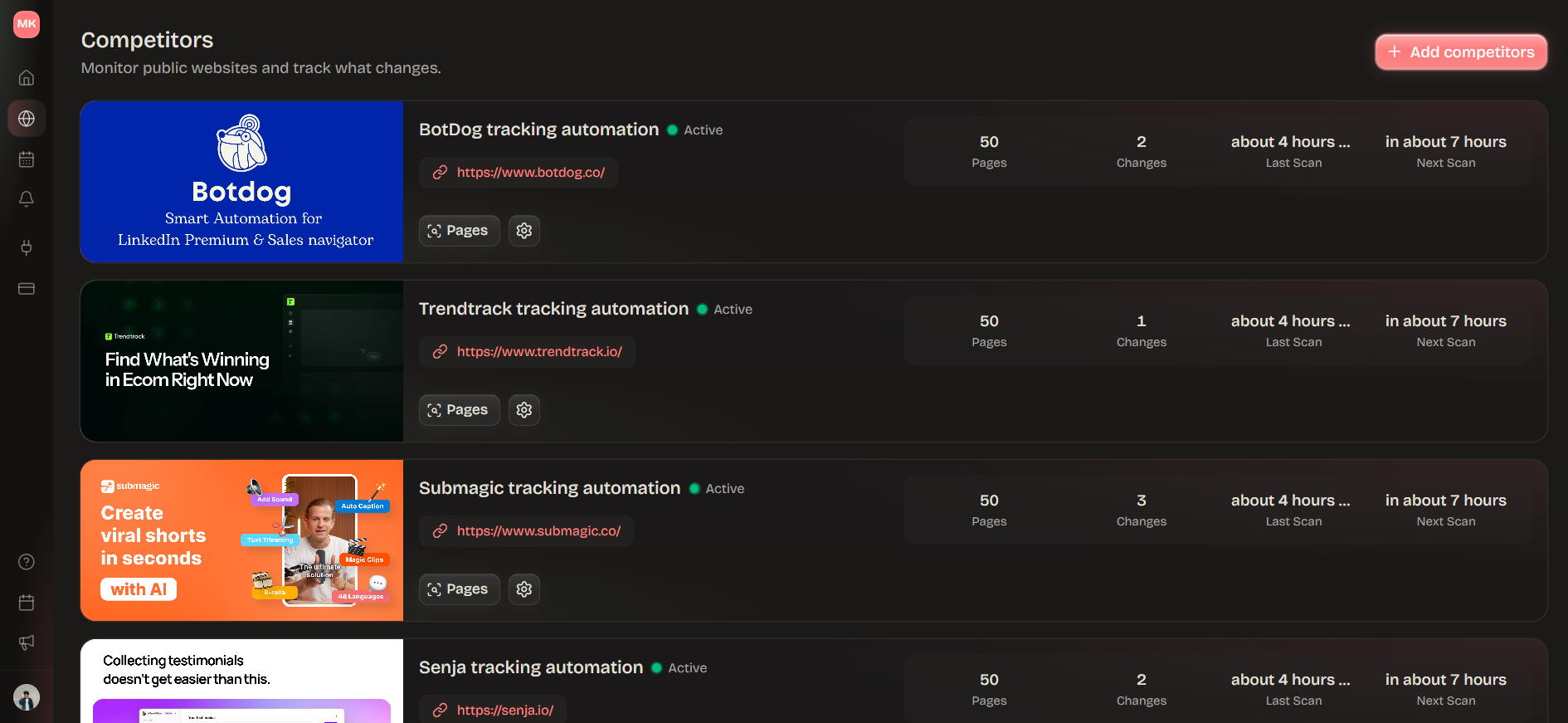
Competitive intelligence
Competitive Intelligence Report: A Practical Guide
Build a competitive intelligence report that turns verified competitor signals into decisions for sales, product, marketing, and leadership.

A competitive intelligence report turns scattered competitor signals into a decision your team can act on. The useful version is not a 40-page archive of screenshots: it states what changed, shows the evidence, explains what the change might mean, and assigns the next move.
What is a competitive intelligence report?
For the recurring system that keeps reports current, see our guide to building a competitive intelligence program.
For a worked example of a dated market-signal study, see our analysis of 62 B2B SaaS comparison pages. The method keeps the source corpus, normalization rules, findings, and limitations visible instead of presenting a page count as proof of buyer demand.
A competitive intelligence report is a structured document that collects, verifies, and interprets information about competitors so a specific team can make a better decision. It can cover pricing, packaging, product pages, positioning, campaigns, hiring, customer proof, distribution, or changes in a competitor’s public website.
The important distinction is between a report and a research dump. A research dump answers “What did we find?” A report answers “What matters, how certain are we, and what should happen next?” Meltwater describes the same shift from monitoring to decision-ready insight, while Sprinklr emphasizes credible data, explicit implications, and prioritized recommendations.
For example:
- Observation: A competitor moved a reporting feature from its Team plan to its Business plan on September 3.
- Evidence: The current pricing page and an archived snapshot show the plan boundary and the dates checked.
- Interpretation: The competitor may be increasing monetization around reporting, but the page alone does not prove the reason.
- Action: Product marketing updates the comparison page, sales receives a pricing objection note, and product checks whether the same capability is a buying criterion in active deals.
That format is more valuable than saying “the competitor is moving upmarket.” The latter may be true, but it is a hypothesis until other signals support it.
Start with the decision, not the competitor
Before collecting URLs, write the decision the report must support. This single step keeps competitive intelligence from expanding into an endless list of interesting facts. Unkover’s current report guide makes the same point: define the decision first, then limit collection to information that can affect it.
Good report questions are specific:
- Should we change how we package a feature for mid-market buyers?
- Which competitor is most likely to appear in next month’s sales opportunities?
- Does a competitor’s new comparison page expose a messaging gap we should address?
- Which product gaps should we validate with customers before the next roadmap review?
- What changed in the market since the last launch, pricing review, or board meeting?
Weak questions produce weak reports. “Tell us everything about our competitors” has no stopping rule, no audience, and no useful definition of success.
Write the decision at the top of the working document. Then add the audience, time horizon, competitor set, and threshold for action.
| Field | Example | Why it matters |
|---|---|---|
| Decision | Should we change our reporting package? | Defines the job of the report |
| Audience | Product marketing and sales leadership | Determines the output format |
| Time horizon | Next 90 days | Prevents irrelevant history from taking over |
| Competitors | Three direct, one substitute | Keeps the comparison manageable |
| Action threshold | A change affects an active segment or deal | Stops low-value noise being escalated |
If a finding cannot influence the decision, put it in a reference log rather than the main report.
What belongs in a competitive intelligence report?
The exact sections depend on the decision, but a reliable report has six layers. The order matters because readers need the conclusion before the method and the detail.
1. Executive summary
Write this last, but place it first. Give the reader three to five points:
- What changed since the last report?
- Why does it matter to this business?
- What should happen next, and who owns it?
This is not an introduction to your research process. It is the smallest useful version of the report. Oppira recommends leading with the conclusion, then limiting each finding to an observation, evidence, implication, and recommendation. That is a good standard for busy executives and sales leaders.
2. Scope and competitor set
State which companies are included and why. Separate:
- Direct competitors: solve a similar problem for a similar buyer.
- Indirect competitors: solve the problem through a different category or workflow.
- Substitutes: internal work, spreadsheets, agencies, or adjacent tools.
- Potential competitors: companies that could enter the category or move toward the same buyer.
Do not include a company because it appeared in a search result. Include it because its actions can change the decision in front of you. Start small. Three to five competitors are often enough for a focused report; add more only when they change the conclusion.
3. Evidence and source register
Every important claim needs a source, an observation date, and a confidence label. For public website research, keep the source link next to the claim rather than collecting links in a detached appendix.
Useful fields include:
| Field | What to record |
|---|---|
| Competitor | Canonical company name |
| Page or source | Exact URL, filing, interview, or customer evidence |
| Page type | Pricing, product, comparison, changelog, careers, content, or legal |
| Observation date | When the evidence was checked |
| Previous state | What was visible before, if available |
| Current state | What is visible now |
| Confidence | High, medium, or low, with a reason |
| Implication | The decision this may affect |
| Owner | Person or team responsible for the next step |
For example, a competitor’s pricing page is strong evidence of what it publicly offers. It is not proof of discounting, adoption, profitability, or customer satisfaction. A job post can show that a role is open; it cannot prove a product launch date. Keeping those boundaries visible is what makes the report trustworthy.
4. Competitor profiles and comparisons
Give each competitor the same minimum fields so the report does not become a collection of different narratives. Capture the target audience, core problem, positioning language, product scope, pricing model, proof, buying motion, key pages, and recent changes.
Normalize before comparing. A monthly per-seat price is not directly comparable with an annual per-workspace price. A feature listed on a comparison page is not necessarily available on every plan. Mark unknowns instead of filling gaps with assumptions.
For a SaaS report, a compact comparison might look like this:
| Dimension | Ryvalise | Competitor A | Competitor B |
|---|---|---|---|
| Primary job | Monitor meaningful competitor website changes | Track selected page regions | Broader sales intelligence |
| Evidence surface | Page snapshots, changes, source evidence | Visual or element changes | Multiple external data sources |
| Buying motion | Demo or workspace workflow | Self-serve monitoring | Sales-led platform |
| Key unknown | Which alerts lead to decisions | How much review is manual | Which sources are first-party |
The purpose is not to make your product win every row. The purpose is to expose where the decision actually depends on evidence.
5. Interpretation and confidence
Separate the fact from the explanation. Use this sentence pattern:
> We observed X on source Y on date Z. This may indicate hypothesis A, but confidence is high/medium/low because reason. We will check evidence B before recommending action C.
Use a simple priority matrix:
| Consequence | Confidence | Treatment |
|---|---|---|
| High | High | Share immediately and assign an owner |
| High | Low | Investigate or corroborate before acting |
| Low | High | Record or include in a digest |
| Low | Low | Archive unless a pattern develops |
This prevents a dramatic interpretation from outranking a quieter but better-supported finding.
6. Recommendations and decision log
Finish every major finding with a decision, an owner, and a review date. “Keep an eye on it” is not an action. A useful recommendation might be:
- Product marketing: update the comparison page by Friday.
- Sales enablement: add one objection response to the battlecard before the next pipeline review.
- Product: interview five customers about the changed capability before roadmap planning.
- Strategy: continue monitoring the competitor’s pricing and comparison pages weekly for 30 days.
Record what was decided, what was rejected, and what remains unknown. A rejected recommendation with a reason is valuable because it stops the same question from returning without new evidence.
Use one research layer to serve four audiences
One long report rarely works for everyone. The research can be shared, but the output should match the reader’s job. Crayon’s competitive intelligence database template makes the case for centralizing research so it can feed sales enablement instead of living in isolated files.
| Audience | They need | Best format | Typical cadence |
|---|---|---|---|
| Leadership | Position movement, risks, and decisions | One-page memo | Monthly or quarterly |
| Sales | Changed objections, proof, and competitor claims | Battlecard diff or short deal note | When a signal matters |
| Product | Closed gaps, open gaps, packaging, and customer impact | Comparison table plus evidence | Biweekly or monthly |
| Marketing | New messages, offers, campaigns, and source material | Change log plus interpretation | Weekly |
Sales should not receive the same document as leadership. A rep preparing for a call needs a verified claim, the source, the caveat, and the response—not a ten-page history of the market.
Turn the report into a sales note with four fields:
- What the buyer may say: “They now include this feature on the lower plan.”
- What we can verify: the public plan boundary and date checked.
- How to respond: explain the difference in workflow, evidence, or total cost without making claims the source cannot support.
- What not to say: do not claim the competitor is unreliable, desperate, or losing customers unless you have direct evidence.
That final field matters. Competitive intelligence should make sales more credible, not encourage unsupported attacks.
Create a cadence that matches the decision speed
Reports become stale when the cadence is based on the analyst’s calendar instead of the decision’s half-life. A pricing change in an active deal may need same-day review. A quarterly positioning review can use a monthly report. A low-consequence blog update may only belong in a digest.
Use a layered cadence:
- Continuous collection: monitor high-signal pages and preserve source evidence.
- Weekly triage: group changes, remove noise, and identify findings worth sharing.
- Monthly synthesis: connect patterns to positioning, pricing, product, and sales decisions.
- Quarterly reset: review the competitor set, source quality, ownership, and thresholds.
Ryvalise is designed for the collection layer: it can discover relevant competitor pages, classify page types, preserve monitoring history, and surface meaningful changes. The report still needs a human decision rule. Automation should reduce the time spent finding evidence, not pretend that every page edit reveals intent.
Common mistakes that make reports useless
Starting with a giant competitor list
More competitors create more rows, not necessarily more insight. Start with the companies that can affect the decision and expand only when the evidence says you should.
Treating every change as important
Cookie banners, timestamps, rotating testimonials, tracking parameters, and layout noise are not strategy. Define page-specific importance rules and review low-consequence changes in a digest.
Hiding the source
Readers should not have to ask where a claim came from. Put the source beside the sentence or table row it supports, with the checked date when timing matters.
Confusing activity with impact
A new blog post, job listing, or landing-page headline shows activity. It does not prove revenue, adoption, or a roadmap shift. Label the interpretation and state what would confirm it.
Writing one format for everyone
An executive memo, a sales battlecard, and a product gap review can come from the same evidence, but they should not have the same length or level of interpretation.
Publishing and forgetting
A report is an operating artifact, not a one-time presentation. Add a review date, preserve previous states, and record which findings led to action. If nobody uses a signal, lower its priority or change its format.
A reusable competitive intelligence report template
Copy this outline into your next report:
- Decision: What decision must this report support?
- Audience and date: Who needs it, and what period does it cover?
- Executive summary: Three to five findings, implications, and recommendations.
- Competitor scope: Included companies and the reason for each.
- Evidence register: Source, date, previous state, current state, confidence.
- Comparison: Normalized view of positioning, product, pricing, proof, and motion.
- Findings: Observation, evidence, implication, confidence, and owner.
- Audience outputs: Leadership memo, sales update, product implications, and marketing change log.
- Decision log: Accepted, rejected, pending, and next review date.
- Appendix: Detailed screenshots, raw notes, and supporting data.
If you already have a competitor analysis template, add the decision, confidence, owner, and audience-output fields. The competitive intelligence program guide covers the recurring scope and ownership behind the report, while the battlecard guide shows how to turn verified findings into a concise sales asset.
Frequently asked questions
What is the purpose of a competitive intelligence report?
Its purpose is to turn verified information about competitors and the market into a decision, recommendation, or owned next action. It should reduce uncertainty rather than simply collect more facts.
What should a competitive intelligence report include?
Include the decision, audience, competitor scope, executive summary, dated sources, comparable competitor profiles, findings with confidence labels, recommendations, owners, and a decision log. Add detailed research in an appendix when necessary.
How often should a competitive intelligence report be updated?
Match the cadence to the decision. Use continuous collection and weekly triage for high-signal changes, then create monthly or quarterly summaries for strategic decisions. Update immediately when a change affects an active deal or launch.
What is the difference between competitor research and competitive intelligence?
Competitor research collects information about named companies. Competitive intelligence adds interpretation, context, confidence, and a recommended action tied to a business decision.
How do you make a competitive intelligence report credible?
Use current and traceable sources, record the date checked, normalize comparisons, separate facts from hypotheses, label uncertainty, avoid unsupported intent claims, and show who owns the next step.

Mehdi Khoudali
Founder, Ryvalise
Book a demo
Let’s make competitor monitoring useful for your team.
A relaxed 20-minute conversation to understand your workflow, show you Ryvalise, and answer anything before you get started.
We can talk about
- Your monitoring priorities
- Setting up your first competitor
- How alerts fit your workflow
Pick any time that works for you. You’ll get a calendar invite with the call details.