Competitive intelligence
Competitor Analysis Example
Follow a practical competitor analysis example for a SaaS team comparing positioning, pricing, product proof, and next actions.
This competitor analysis example follows a fictional B2B SaaS team comparing three alternatives before a positioning and packaging review. The names and findings are illustrative; the method is designed to show how to collect evidence without inventing private facts.
A competitor analysis example starts with a question
This competitor analysis example starts with a decision instead of a generic company profile.
The business question
The team wants to know how competitors present a similar workflow, package the product, prove value, and route buyers into self-serve or sales. The output must help product marketing update messaging and help sales prepare for active comparisons.
The comparison schema
The team uses the same fields for each company and records the source and observation date. It avoids ranking a company on an unsupported “best” score.
| Field | Example observation |
|---|---|
| Audience | Mid-market operations teams |
| Core promise | Reduce manual workflow time |
| Buying motion | Free trial, demo, or hybrid |
| Proof | Customer story and outcome claim |
| Product signal | New integration or feature page |
| Open question | Which usage unit fits the buyer? |
Example finding 1: positioning
Company A leads with speed, Company B leads with control, and Company C leads with cross-team visibility. These are observed framing choices from the companies’ public pages. The team should not conclude that one company owns the category simply because it uses a word more often.
The action is to test whether current customers describe the problem in one of the same frames. The public pages create a messaging hypothesis; customer research validates it.
Example finding 2: pricing
Company A displays plans by seat. Company B uses a workspace unit. Company C shows a starting plan and asks larger buyers to contact sales. The team creates a scenario for five users, one workspace, the required integration, and monthly billing, then marks unknown overage terms explicitly.
The action is not to declare a cheapest competitor. It is to check whether the team’s own pricing page makes the same scenario easy to understand.
| Competitor | Displayed unit | Scenario result | Confidence |
|---|---|---|---|
| A | Per seat | Derived from public plans | Medium |
| B | Per workspace | Usage terms need confirmation | Medium |
| C | Sales-assisted | Public price unavailable | High for CTA |
Example finding 3: product and proof
Company B adds an integration page and a customer story that both mention the same workflow. That sequence is stronger than either page alone as a reason to ask whether the capability is becoming a go-to-market priority. It is still not proof of roadmap size or revenue impact.
The action is to ask product and sales whether the integration appears in recent customer conversations and whether a battlecard needs an update.
Example finding 4: change monitoring
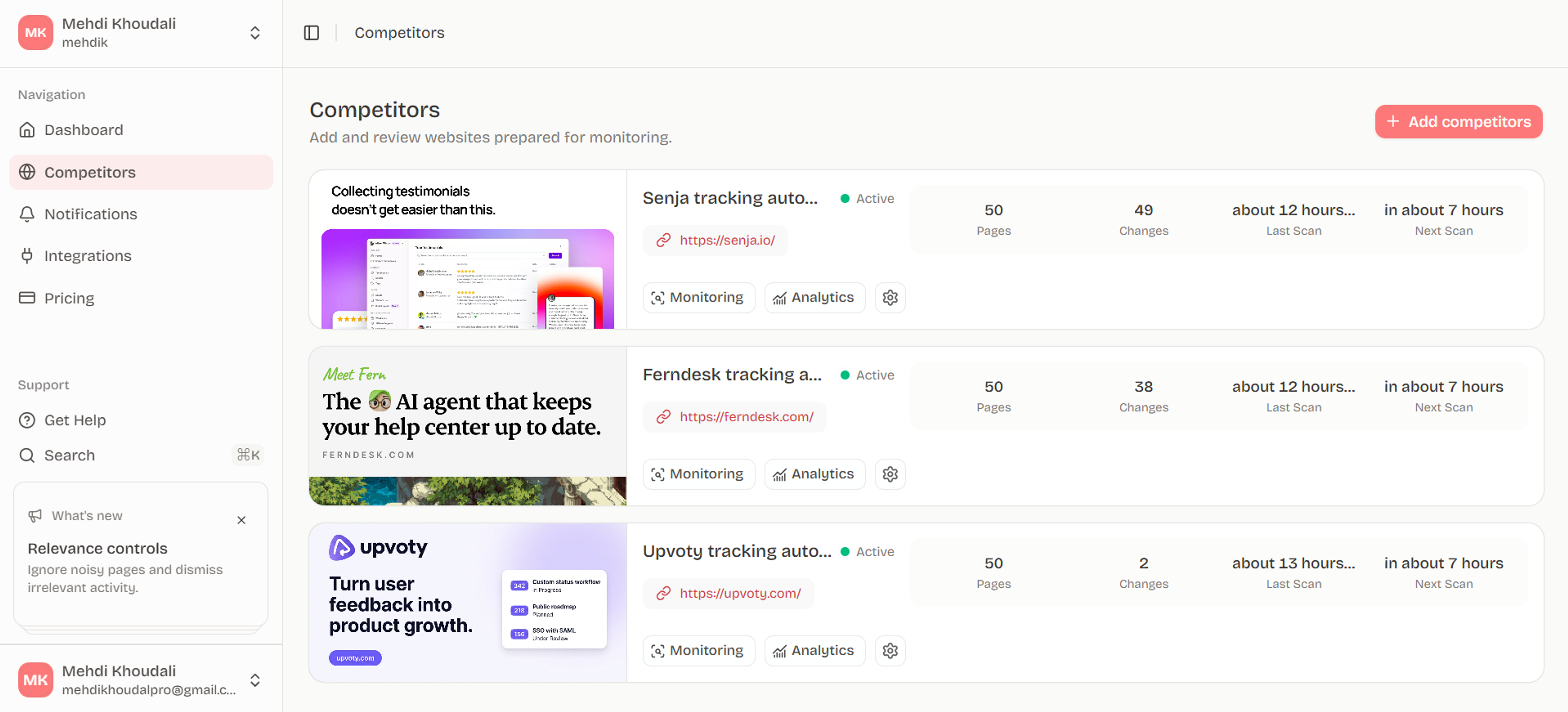
The team chooses five pages per competitor: homepage, pricing, core product, comparison, and changelog or content hub. It marks pricing and product as high importance, comparison as medium, and the content hub as digest-only until it demonstrates useful signals.
Ryvalise can keep this evidence current by discovering related pages, classifying them, comparing stable content, and attaching source evidence to meaningful activity.
What the final recommendation looks like
The report ends with three owned actions: test a clearer value frame in messaging, document a common pricing scenario, and validate the recurring integration signal with sales. It also states what is unknown and what evidence would change the recommendation.
How the example avoids false precision
Notice that the example does not assign a universal competitor score or claim that a plan is cheaper without a normalized scenario. It uses confidence labels, keeps unknown terms visible, and treats public copy as evidence of messaging rather than proof of product quality. This is important because competitive analysis can sound authoritative while resting on incomplete pages.
A strong report gives readers a way to disagree productively. They can challenge the scenario, add a missing source, change the confidence, or assign a different owner. The evidence remains useful even when the first interpretation changes.
A reusable final-report layout
Open with the decision and one-sentence conclusion. Follow with the competitor matrix, the three to five highest-consequence findings, evidence links, unknowns, and an action table. Put the full research archive after the decision summary so busy readers can act quickly while analysts retain detail for review.
| Report section | Reader question |
|---|---|
| Decision | What are we trying to decide? |
| Findings | What changed or differs? |
| Evidence | Where can I verify it? |
| Implication | Why might it matter? |
| Action | Who does what next? |
What the example would monitor next
The team would not freeze the analysis after publishing the report. It would monitor the pages behind the most important findings and look for confirmation or change. If Company B’s integration signal disappears, the confidence should fall. If the same message appears across a product page, comparison page, and customer story, the hypothesis becomes more useful for review.
This is the difference between a one-time competitor analysis and an intelligence habit. The first explains the current picture. The second preserves the evidence needed to notice when that picture changes.
Frequently asked questions
What should a competitor analysis example include?
Include the business question, competitor set, comparison fields, source evidence, observed differences, confidence, interpretation, limitations, and next actions.
Can competitor analysis use fictional examples?
Yes, fictional examples can explain the method. Actual strategic conclusions should use current, cited evidence from the relevant competitors and should label assumptions.
How do I compare competitor pricing in an example?
Choose one buyer scenario, normalize the billing unit and period, record limits and feature gates, and distinguish displayed values from derived values.
What makes a competitor finding actionable?
It connects a meaningful observation to an owner, decision, and next step. A fact with no decision context may belong in the research archive instead.
How often should an example analysis be refreshed?
Refresh the evidence as meaningful changes occur and revisit the structured conclusion when the market, product, or decision changes.
Put the research into motion
Use the same evidence discipline for your own competitor set with a living Ryvalise monitoring workspace.
Start with Ryvalise