Competitive intelligence
Competitive Analysis Framework
Use this competitive analysis framework to connect market questions with comparable evidence, confidence, owners, and decisions.
A competitive analysis framework turns scattered research into a repeatable decision process. The strongest framework connects a business question to comparable evidence, confidence, ownership, and a next action while keeping published facts separate from interpretation.
Build a competitive analysis framework
A competitive analysis framework is most useful when it connects evidence to an owned decision.
The five-layer framework
Use five layers: scope, evidence, comparison, interpretation, and action. Each layer solves a different failure mode. Scope prevents research sprawl. Evidence prevents unsupported claims. Comparison prevents one-off anecdotes. Interpretation makes the data useful. Action prevents a report from becoming a static file.
| Layer | Question | Deliverable |
|---|---|---|
| Scope | What decision are we supporting? | Research brief |
| Evidence | What can we verify? | Dated source record |
| Comparison | How are companies different? | Normalized matrix |
| Interpretation | Why might it matter? | Hypotheses and confidence |
| Action | Who does what next? | Owned decision queue |
Scope the market question
Write the audience, decision, time horizon, and competitor set. A pricing framework needs a buyer scenario and billing assumptions. A positioning framework needs a defined segment and category. A product framework needs a capability boundary and evidence standard.
Do not call every company in a broad category a competitor. Include a company because it can affect the decision, not because it appears in a list.
Create an evidence schema
Use stable fields: company, page or source, observation date, audience, offer, proof, motion, change, confidence, and owner. Keep the source link beside the claim. If the source is dynamic, preserve the relevant before-and-after context.
For website research, classify pages by job: pricing, product, solution, comparison, integration, changelog, customer story, careers, legal, or content hub. Page type helps explain why a change matters without turning a raw diff into strategy.
Normalize before comparing
Define the unit of comparison. Compare the same buyer, usage, geography, billing period, required feature, and sales path. Mark unknowns explicitly. A matrix is only useful when readers can see which values are displayed, derived, or missing.
Rank by consequence and confidence
Use a simple 2x2: high or low consequence crossed with high or low confidence. A confirmed plan change may be high confidence and high consequence. A single job posting may be low confidence even if the implied strategy sounds important.
| Priority | Treatment |
|---|---|
| High consequence, high confidence | Share and assign an owner |
| High consequence, low confidence | Investigate and corroborate |
| Low consequence, high confidence | Record or group in a digest |
| Low consequence, low confidence | Archive unless a pattern emerges |
Write interpretations responsibly
State the observed fact first, then the hypothesis, then the evidence needed to strengthen or weaken it. Avoid claiming intent from a single edit. Look for sequences across pricing, product, comparison, proof, and conversion pages.
Operationalize the framework
Set a review cadence and a change policy. High-consequence pages can generate immediate review; routine page changes can feed a daily or weekly brief. Track which findings lead to decisions and tune page priorities from outcomes.
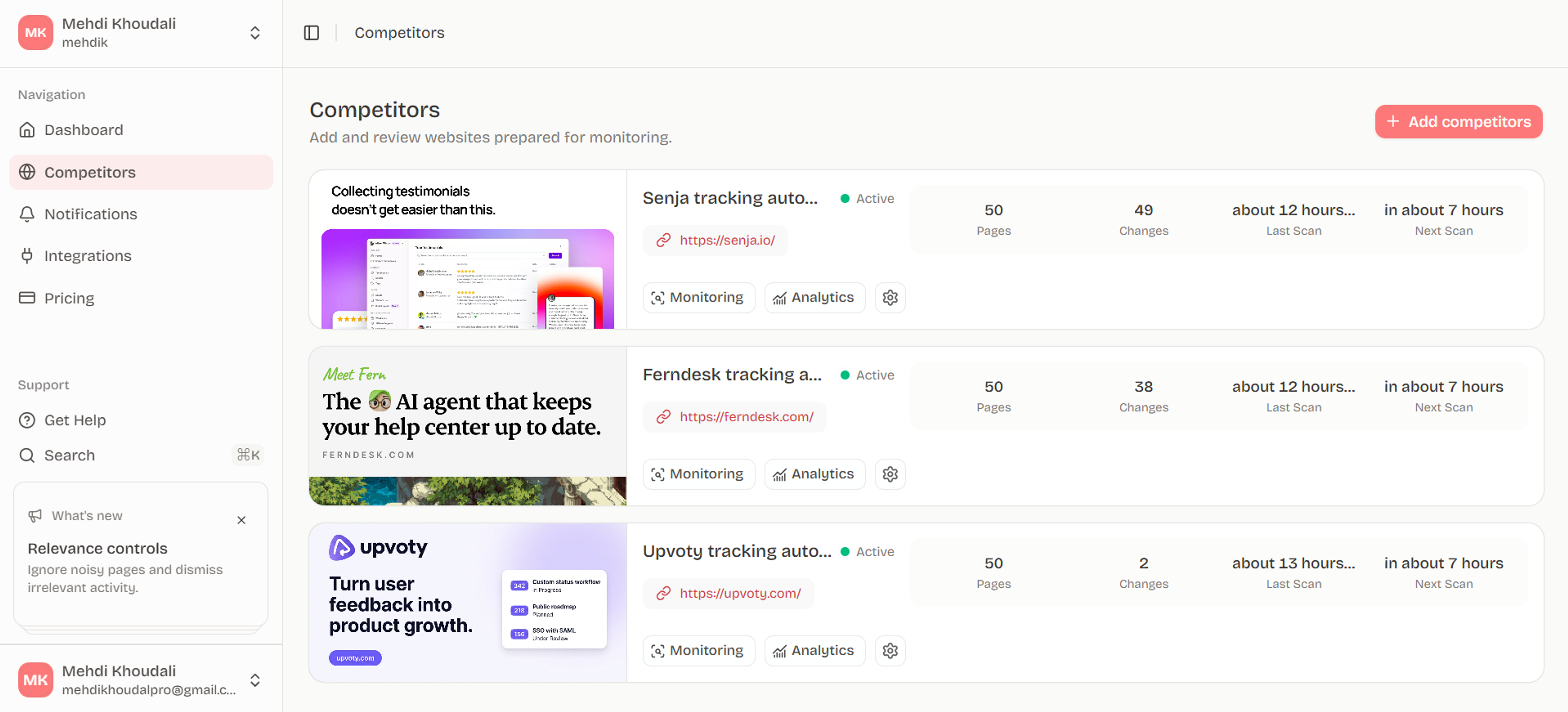
Ryvalise supports this framework at the website layer by discovering pages, classifying page types, preserving monitoring history, and summarizing meaningful changes. It helps the framework stay current without making AI interpretation the source of truth.
Add a confidence and freshness layer
Every finding should have a freshness date and a confidence note. A pricing page checked yesterday is different from a pricing page last reviewed six months ago. A current product claim can be high-confidence as published copy while remaining low-confidence as evidence of adoption.
Use freshness to prevent stale analysis from becoming institutional memory. When a finding is older than the decision window, send it back to collection. When a source disappears, preserve the last observed state and label the current state unknown rather than silently deleting the finding.
Turn the framework into a meeting format
Use the same order in every review: material changes first, unresolved hypotheses second, decisions and owners third. This makes meetings shorter because the team learns where evidence belongs. It also creates a feedback loop for the monitoring program: signals that never reach the decision section should be lower priority next time.
Add a decision threshold
Not every difference deserves a recommendation. Define a threshold before the review: the change must affect a priority buyer, a current product decision, an active deal, or a material risk. This keeps the framework from escalating interesting but irrelevant facts.
Use a simple action matrix. Investigate when consequence is high but confidence is low. Share when both are high. Digest when confidence is high but consequence is low. Archive when both are low. The matrix can be applied consistently even when the content changes.
Frequently asked questions
What is a competitive analysis framework?
It is a repeatable structure for scoping a market question, collecting comparable evidence, interpreting differences, and assigning actions. It prevents research from becoming an unranked list of observations.
Which framework is best for competitor analysis?
Use the framework that maps to your decision. The five-layer scope, evidence, comparison, interpretation, and action model works across pricing, product, positioning, and sales questions.
How do I make a competitor framework objective?
Define fields and evidence rules before collecting data, record unknowns, cite sources, separate facts from hypotheses, and state limitations. Objectivity improves when another reviewer can reproduce the comparison.
How many competitors should a framework include?
Use enough to answer the decision, usually three to eight at the start. Add more only when they change the conclusion or reveal a distinct market pattern.
How often should the framework be updated?
Maintain high-signal source evidence continuously or on a regular cadence, then refresh the structured analysis when decisions, products, or market conditions change.
Put the research into motion
Put the framework into a living monitoring workflow so your next analysis starts with current, source-backed evidence.
Start with Ryvalise