Competitive intelligence
Competitor Analysis Template
Use this practical competitor analysis template to capture positioning, pricing, product, proof, and next actions in one repeatable view.
A competitor analysis template gives your team a consistent way to compare companies, record evidence, and turn observations into decisions. A useful template should capture the source, date, audience, offer, proof, and implications without confusing a public fact with a private assumption.
How to use a competitor analysis template
A competitor analysis template works best when every row has a source, date, and next action.
The core competitor analysis template
Copy this structure into a document or workspace and create one row per competitor. Keep evidence close to the statement it supports. If a field is unknown, write unknown; do not fill it with a guess.
| Field | What to record | Evidence |
|---|---|---|
| Company | Name and canonical website | Homepage URL |
| Buyer | Audience and segment language | Homepage or solution page |
| Problem | Job or pain the company leads with | Product copy |
| Offer | Product, plans and packaging | Pricing and product pages |
| Proof | Customers, outcomes and claims | Case studies |
| Motion | Self-serve, sales-led or hybrid | CTA and signup path |
| Changes | New or changed public signals | Dated source link |
| Next action | Decision or owner | Internal note |
Section 1: Company and market context
Record the competitor’s category, target segment, geography, business model, and closest alternatives. This prevents a feature comparison from treating very different companies as if they were interchangeable.
Add a short reason for monitoring the company. It might be a shared customer segment, a product overlap, a pricing comparison in active deals, or an emerging category move. Review this reason when your strategy changes.
Section 2: Positioning and messaging
Capture the homepage headline, supporting promise, named audience, category term, differentiators, proof point, and primary CTA. Note repeated language across product, solution, and comparison pages. Repetition can show what the company wants prospects to remember, but it is not proof that the claim is true.
Write the observation and interpretation separately. “The page now leads with workflow automation” is evidence. “The competitor is abandoning its original segment” is a hypothesis that needs more than one page.
Section 3: Pricing and packaging
Record plan names, visible price, currency, billing period, value metric, usage limits, feature gates, discount language, free access, minimum commitment, and sales qualification. Preserve the assumptions behind any comparison.
| Pricing field | Example value | Comparison caution |
|---|---|---|
| Unit | Per seat | Do not compare with per-workspace directly |
| Billing | Monthly or annual | Note discounts and commitments |
| Limit | Projects or usage | Define the unit |
| Gate | Feature on a higher tier | Capture the plan boundary |
| CTA | Start trial or contact sales | Shows buying motion, not revenue |
Section 4: Product, proof and motion
List major capabilities, integrations, use cases, customer stories, review themes, hiring topics, and launch activity. Focus on what a buyer can verify. Avoid turning a logo or a job posting into a conclusion about adoption or roadmap certainty.
Section 5: Changes and decision log
Add a dated row whenever a meaningful public change occurs. Include the page type, previous state, current state, source URL, importance, confidence, and owner. A simple change log makes it possible to detect sequences instead of reacting to isolated edits.
Use a monthly review to remove stale assumptions, promote recurring signals, and lower the priority of sources that never change a decision. A template should become more useful with use, not more complicated.
How to turn the template into a system
Use the template as the schema for your monitoring workflow. Automate the recurring collection of public pages, then reserve human time for classification and decisions. This keeps the data fresh without asking analysts to retype the same company description every week.
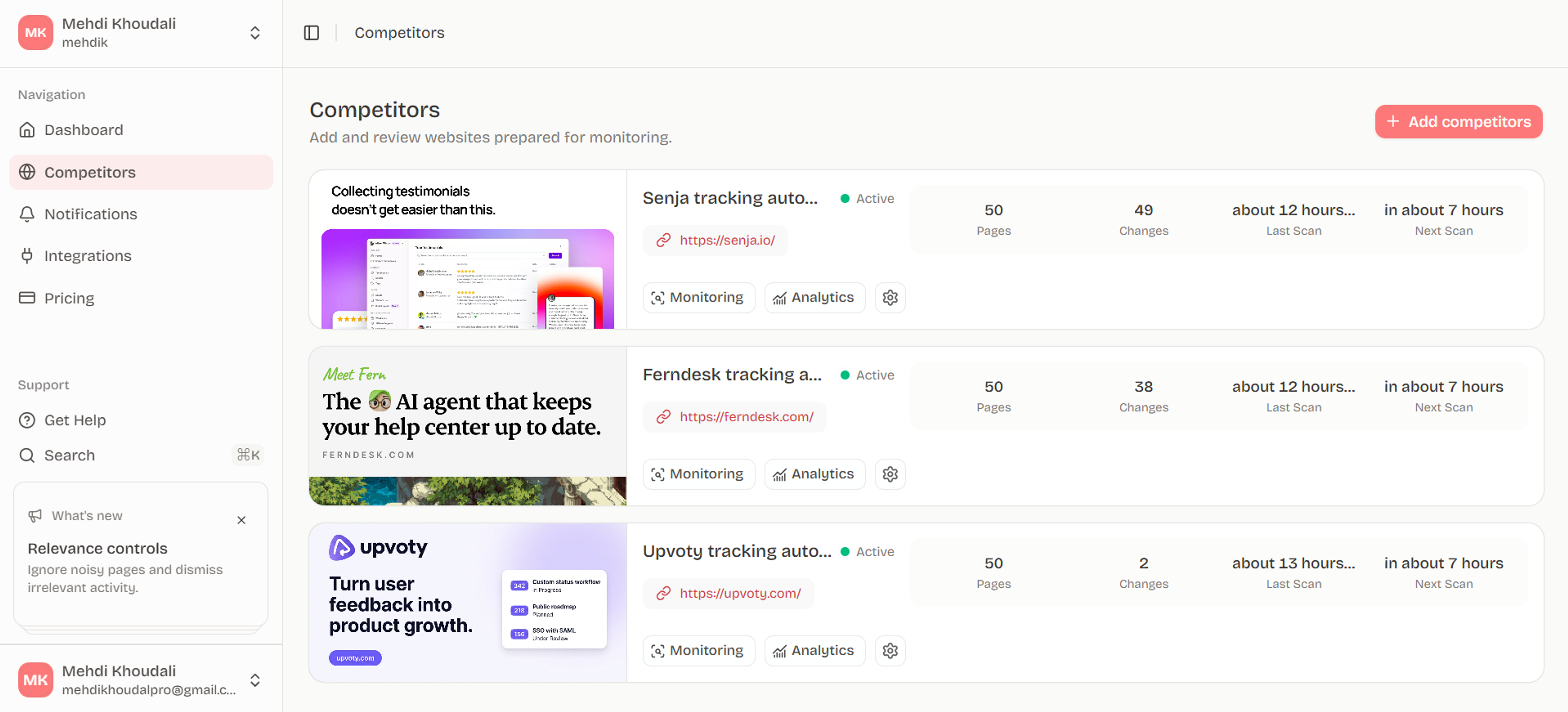
Ryvalise provides the evidence layer by crawling competitor websites, classifying pages, preserving source snapshots, and summarizing meaningful changes. Use it to keep the change-log fields current while your team owns the strategic interpretation.
Add a source and confidence column to every claim
The most useful improvement to a basic template is provenance. Add the exact page, observation date, and confidence beside any claim that might influence product, pricing, or sales. If a statement is derived from several pages, list each page rather than hiding the chain of reasoning.
Add a freshness rule as well. A current pricing row may need weekly review, while a company-history row may need only quarterly review. The template should tell you when a field must be checked again, not just where to store the last answer.
Keep the template readable for its audience
Analysts may need detailed evidence, but executives and sellers need a compact decision view. Use a summary row, a few high-consequence findings, and links to the research record. Do not copy every observation into the headline section. The template works when different readers can use the same source without receiving the same amount of detail.
Frequently asked questions
What should a competitor analysis template include?
Include company context, audience, positioning, product, pricing, proof, buying motion, changes, sources, assumptions, and next actions. The exact fields should follow your decisions.
How many competitors should the template cover?
Start with three to eight meaningful competitors. Add indirect and aspirational companies only when they answer a specific market question.
How often should a competitor analysis be updated?
Update evidence as changes occur and run a structured review weekly or monthly. Separate collection frequency from decision frequency.
What is the most common competitor-analysis mistake?
The most common mistake is collecting facts without recording why they matter or where they came from. A second is presenting a hypothesis as if it were observed evidence.
Can I automate a competitor analysis template?
You can automate recurring collection, page comparison, and routing. Human review is still needed for ambiguous changes, context, and decisions that affect strategy.
Put the research into motion
Replace scattered competitor notes with a living, evidence-backed monitoring workspace in Ryvalise.
Start with Ryvalise