Pricing research
How Should SaaS Companies Price AI Features in 2026?
Learn how to price AI features with a practical framework for value metrics, margins, packaging, usage limits, and competitor monitoring.

SaaS companies should price AI features around a customer-visible unit of value, then protect that promise with a measurable usage boundary. For most products, the strongest starting point is a hybrid model: a recurring platform or seat fee with an included allowance, followed by transparent credits, usage, or outcome-based charges. That structure keeps the first purchase understandable while preventing heavy AI consumption from silently destroying gross margin.
What makes pricing AI features different from pricing ordinary SaaS?
Traditional SaaS pricing often assumes the marginal cost of another click, record, or workflow is small. AI features can have a more variable cost base. Model choice, input length, output length, retrieval, tool calls, retries, latency requirements, and human review can all change the cost of delivering what looks like one feature.
Customers face uncertainty too. A buyer may not know how many prompts, generated assets, automated cases, or agent actions the team will use next month. Pure usage pricing transfers that uncertainty to the buyer. Unlimited access transfers it to the vendor. Good pricing shares the risk deliberately.
That is why the pricing unit must do three jobs:
- feel connected to the value the customer receives;
- be predictable enough for the customer to budget;
- remain measurable enough for the vendor to protect margin.
A token may describe your infrastructure bill, but it rarely describes customer value. “Resolved support conversation,” “processed document,” or “completed research run” can be easier to understand. The correct unit sits as close to the outcome as you can reliably measure without creating disputes.
Which AI pricing model should you choose?
Start by comparing the five common models against your product’s value and cost behavior. The model is a packaging decision, not merely a billing implementation.
| Pricing model | Best when | Main advantage | Main risk |
|---|---|---|---|
| Bundled into the plan | AI is becoming a baseline capability and usage is inexpensive | Simple adoption and procurement | Heavy users can erode margin |
| Per-seat add-on | AI primarily improves each licensed user’s productivity | Familiar and predictable | Seats may not track compute or value |
| Metered usage | Cost and value both rise with a clear unit | Direct margin control | Buyers may fear an unpredictable bill |
| Credits | Several AI actions need one shared commercial unit | Flexible across features and models | Opaque conversion rates can reduce trust |
| Per outcome | Success can be defined and audited consistently | Strong alignment with customer value | Attribution and edge cases can cause disputes |
When should AI be bundled into an existing plan?
Bundle AI when it is necessary for the core product promise, has a low and stable marginal cost, or improves retention more than direct monetization. Search assistance, small summaries, classification, and light drafting may qualify. An allowance or fair-use boundary is still useful even when the buyer sees “included.”
Bundling is weaker when one account can consume 100 times more inference than another. In that case, the simple price hides a real cross-subsidy. You may acquire high-usage customers who look valuable in recurring revenue but are unattractive after serving costs.
When does a per-seat AI add-on work?
Use a seat add-on when value is created by making individual employees faster and usage roughly follows the number of enabled users. Copilots for sales, coding, analysis, and customer support often fit this pattern. The add-on gives finance a predictable bill and gives product a clear upgrade path.
The weakness is shared automation. A background agent can perform work for an entire organization while belonging to no single seat. Charging only by seat can underprice that workload or encourage awkward licensing rules. A seat fee plus an included usage pool is usually safer.
When is metered usage the right answer?
Metered pricing is strongest when the billable unit is easy to count, easy to explain, and closely related to both cost and value. API calls, generated minutes, documents processed, and automation runs are clearer than raw model tokens for most buyers.
Stripe’s usage-based billing documentation describes a lifecycle built around ingesting meter events, configuring recurring and usage prices, billing, and monitoring thresholds. That operational detail matters: if you cannot produce an auditable usage ledger or alert a customer before a threshold, the pricing model is not ready for launch.
When should you use credits?
Credits are useful when a product offers several AI actions with different costs. They create one commercial currency across research runs, generations, enrichment, and agent actions. They also let you change the cost mix behind the product without exposing infrastructure units directly.
Credits fail when the conversion table is hidden or constantly changing. Customers should be able to estimate a normal workflow before purchase. Publish representative costs, show the remaining balance, send threshold alerts, and explain whether unused credits expire or roll over.
When can you charge per outcome?
Outcome pricing works when success is observable, valuable, and difficult to manipulate. Intercom, for example, currently lists Fin pricing from $0.99 per outcome, and its outcome documentation defines when a resolution, handoff, disqualification, or qualification becomes billable. The important lesson is not the number; it is the precision of the definition.
Before using outcome pricing, write the dispute policy first. Decide what happens when a user reopens a conversation, the AI needs human help, a workflow partially completes, or two systems claim the same result. If the outcome cannot be audited consistently, charge for a more objective upstream unit.
Why is a hybrid model the safest default for AI SaaS?
A hybrid model combines a predictable commitment with a variable boundary. A customer might pay a platform or seat subscription that includes 1,000 actions, then buy additional usage or credits. This gives the vendor committed revenue and gives the buyer room to learn before variable charges begin.
Current market examples show several versions of this structure. GitHub Copilot’s plans combine monthly subscriptions with included AI credits and additional usage options. Salesforce Agentforce offers consumption-based Flex Credits, conversation pricing, and per-user licensing for different use cases. These are not templates to copy; they demonstrate that one product family may need more than one buying model.
The best default for an early product is usually:
- one recurring plan or add-on that communicates the core promise;
- a meaningful included allowance based on normal use;
- a visible meter and alerts at 50%, 80%, and 100%;
- an explicit policy for overages, hard limits, or top-ups;
- a higher tier with better unit economics for committed volume.
This structure also creates room to learn. You can change included usage for new plans more safely than replacing the entire value metric after customers have built budgets around it.
How do you calculate a defensible starting price?
Price from value, then use cost as a constraint. Cost-plus pricing alone exposes your infrastructure economics without capturing the value of better conversion, fewer support tickets, faster analysis, or reduced manual work.
Step 1: define the job and successful unit
Write one sentence: “The customer uses this feature to achieve ___.” Then identify the smallest measurable unit that represents progress toward that result. A support agent may produce a resolved issue. A research agent may produce a completed, source-backed report. A writing assistant may produce an accepted draft, but acceptance could be difficult to measure consistently.
Step 2: model fully loaded variable cost
Include more than model inference. Count retrieval, embeddings, search or data-provider fees, storage, orchestration, retries, observability, abuse, and any human review. Use a distribution rather than one average: median, high, and extreme use. The OpenAI API pricing page is one current input for model costs, but your actual cost per customer outcome depends on the entire workflow.
Step 3: estimate customer value and alternatives
Quantify time saved, revenue created, risk reduced, or an external tool displaced. Ask buyers how they solve the problem today and what failure costs. A feature that saves ten minutes has a different ceiling from an agent that completes a qualified sales handoff.
Step 4: choose a target contribution margin
Set a floor for the revenue left after variable serving costs. Test the plan at expected use and at the 90th or 95th percentile. If one reasonable power user makes the plan structurally unprofitable, tighten the allowance, add an overage, or move the costly workflow into a higher tier.
Step 5: create three customer scenarios
Model a light, typical, and heavy account. For each, calculate the monthly bill, effective price per successful unit, variable cost, contribution margin, and maximum bill under any guardrail. A pricing page that looks simple can still produce a surprising invoice; scenario testing reveals that before launch.
How should AI usage limits and overages work?
Usage controls are part of the product experience. A small pricing footnote is not enough. The account owner should see what is metered, current consumption, the reset date, estimated remaining capacity, and the consequence of crossing the limit.
Offer one of three explicit behaviors:
- a hard stop, suitable for trials and tightly controlled budgets;
- prepaid top-ups, suitable for self-serve customers who want control;
- automatic overages with budget alerts and optional caps, suitable for mature usage.
Avoid surprise overages by showing unit consumption before an expensive action where practical. For credits, provide examples such as “a standard summary uses about two credits” while making clear when complexity can change the amount. For outcome pricing, expose the evidence that made the outcome billable.
How should you compare competitor AI pricing?
Do not compare only the displayed monthly price. Normalize the full buying scenario: seats, included usage, credit conversion, model access, minimum commitment, overage price, expiration, limits, annual discount, and support requirements.
Capture the full public offer, not just the headline price. For AI products, add these fields to the comparison:
- What event consumes usage?
- Can the buyer predict consumption before acting?
- Are failed attempts, retries, or human handoffs billable?
- Are allowances pooled across users or workspaces?
- Do unused credits expire?
- Can administrators set alerts, caps, or hard limits?
- Does the vendor change the unit across plans?
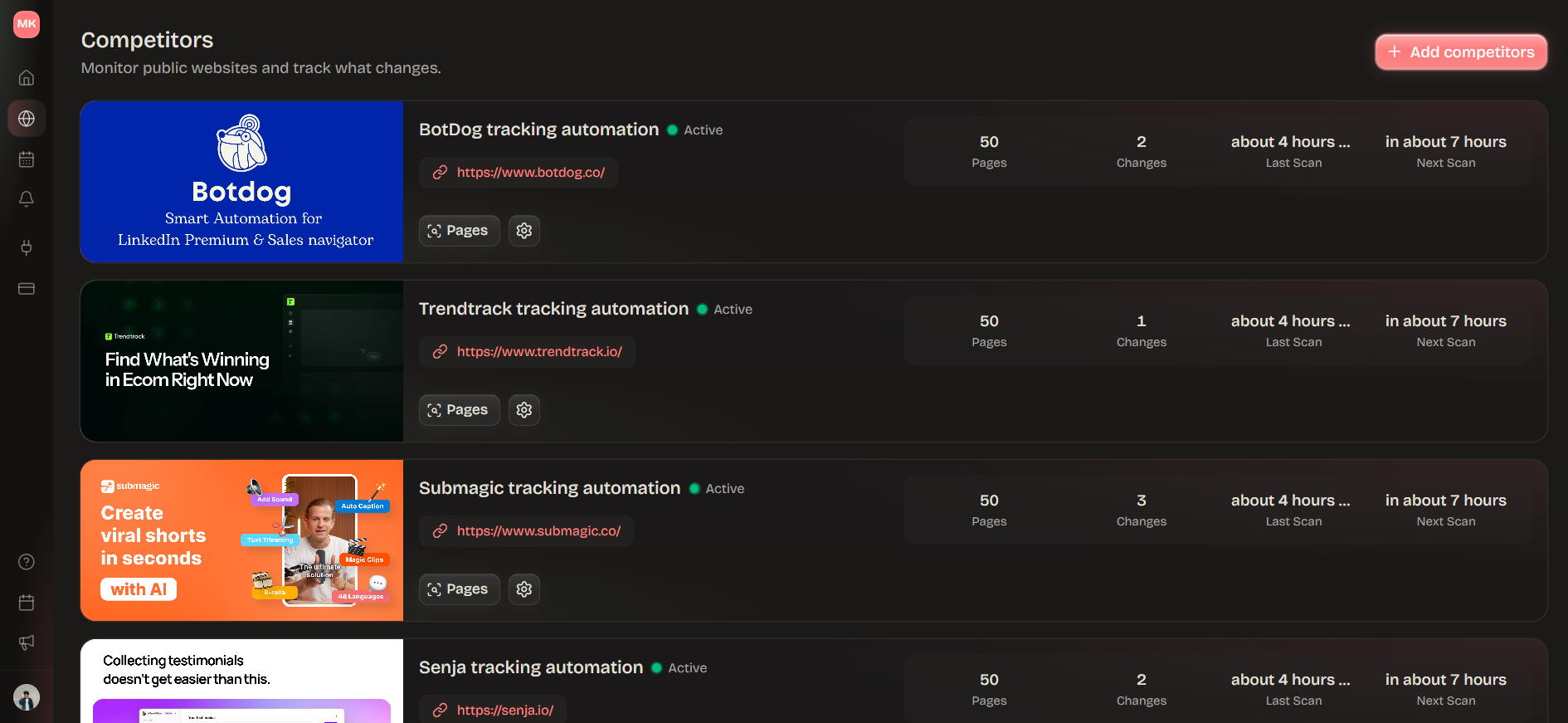
Track changes across pricing pages, help documentation, rate cards, and signup flows. A stable headline price can hide a smaller allowance, a new multiplier, or a feature moved behind a higher tier. A competitive intelligence dashboard should link each pricing conclusion back to the dated page evidence.
What should you test before launching the price?
Run the proposed model through customer interviews and a controlled commercial test. Ask buyers to estimate their bill from the pricing page. If they cannot, simplify the unit or add a calculator. Present two or three packages and listen for objections about predictability, fairness, and procurement—not only willingness to pay.
Instrument the launch around business outcomes:
- activation and repeat use of the AI feature;
- allowance consumption by customer segment;
- upgrade, top-up, and overage behavior;
- gross margin by account and workflow;
- abandonment after usage warnings;
- support tickets and disputes related to billing;
- retention for adopters compared with similar non-adopters.
Use a pricing council with product, finance, engineering, sales, and customer success. Engineering validates metering and cost. Finance validates margin and recognition. Sales and success surface predictability objections. Product owns the connection between the unit and value.
When should you revise AI pricing?
Review pricing when customer value, serving cost, or the competitive offer changes materially. A cheaper model does not automatically require a price cut; it may justify a better allowance, higher margin, or investment in quality. Likewise, a competitor’s price change is a signal to investigate, not a command to follow.
Use cohorts to separate a packaging problem from a product problem. Low adoption may mean customers do not understand the feature. High adoption with poor margin may mean the allowance is too generous or the workflow is inefficient. High value with low upgrade conversion may mean the value is hidden inside the base plan.
Preserve historical terms for existing customers when practical, announce changes clearly, and show how the new model affects representative usage. Trust is difficult to rebuild after an unexpected AI bill.
Frequently asked questions
What is the best pricing model for an AI SaaS feature?
For many SaaS products, the safest starting point is a hybrid model: a recurring seat or platform fee with included AI usage and transparent charges or top-ups beyond the allowance. The right model still depends on whether value and cost follow users, actions, usage, or outcomes.
Should AI features be included in the base subscription?
Include AI when it is central to the product and has low, predictable serving costs. Use an allowance, fair-use policy, or higher-tier boundary when usage can vary significantly between customers.
Are credits better than token pricing?
Credits are usually easier for buyers when several AI actions have different infrastructure costs. They are only better if conversion rates are visible, representative examples are available, and customers can monitor consumption.
How much gross margin should an AI feature have?
There is no universal target. Set a contribution-margin floor that fits your company stage and broader SaaS economics, then test it against typical and high-usage accounts. Include every variable serving cost, not only the model bill.
How often should AI pricing be reviewed?
Review the evidence monthly during early rollout and at least quarterly once usage stabilizes. Revisit sooner after a major model, workflow, packaging, or competitor change. Avoid frequent customer-facing price changes when an internal cost or allowance adjustment would solve the problem.

Mehdi Khoudali
Founder, Ryvalise
Book a demo
Let’s make competitor monitoring useful for your team.
A relaxed 20-minute conversation to understand your workflow, show you Ryvalise, and answer anything before you get started.
We can talk about
- Your monitoring priorities
- Setting up your first competitor
- How alerts fit your workflow
Pick any time that works for you. You’ll get a calendar invite with the call details.