Agency operations
How Can Agencies Monitor Competitors for Multiple Clients?
Build a scalable competitor monitoring service for multiple clients with separated workspaces, source-backed alerts, and decision-ready reporting.

Agencies can monitor competitors for multiple clients by giving each client a separate intelligence workspace, standardizing the collection process, and customizing only the questions, competitors, sources, and delivery rules. The scalable unit is not an alert or a report—it is a repeatable client workflow that turns verified website changes into decisions.
Why is multi-client competitor monitoring different?
Monitoring for one business is primarily a research problem. Monitoring for ten or fifty clients is also an operations problem: each account has a different market, competitor set, tolerance for noise, review cadence, and definition of a useful signal.
The right model resembles other multi-account agency systems. Google Ads manager accounts provide one administrative view across client accounts while keeping each client account distinct. Your competitive intelligence operation should follow the same principle: centralized oversight, separated client context.
Without that separation, three predictable failures appear. Analysts confuse similarly named competitors, clients receive irrelevant alerts, and account knowledge lives in the memory of whoever set up the watch. Standardizing the workflow fixes those problems without forcing every client into the same strategy.
Create one operating standard for how your agency collects, verifies, scores, and reports evidence. Then configure the commercial questions inside that standard for each client. A B2B SaaS company may care about pricing tiers, integrations, and release notes. A local service brand may care about offers, locations, reviews, and booking flows. The mechanics can be shared even when the intelligence cannot.
What should you define during client onboarding?
Begin with the decision the client wants to improve, not a long list of competitors. “Track these eight companies” is an input. “Help our sales team answer pricing objections within one business day” is an operating objective.
Document six fields during onboarding:
- Business question: the recurring decision the monitoring service should inform.
- Named competitors: direct alternatives that routinely appear in deals or customer research.
- Emerging threats: adjacent companies, new entrants, or substitutes worth watching at lower intensity.
- Priority signals: the changes that could affect pricing, positioning, campaigns, product, or sales conversations.
- Recipients and cadence: who receives urgent alerts, weekly briefs, and monthly analysis.
- Evidence standard: what must be verified before the agency presents a change as fact.
Ask the client for recent lost-deal notes, positioning documents, sales objections, product launch plans, and existing competitor reports. These materials reveal why a competitor matters. They also prevent the analyst from mistaking general industry activity for a client-relevant development.
Finish onboarding with a written scope. It should name the number of monitored competitors, expected source coverage, review frequency, deliverables, and response time for urgent changes. This makes the service measurable and protects the agency from an unlimited “watch everything” expectation.
How should you structure every client workspace?
Use a common information model while keeping every client’s records and distribution paths isolated. The table below separates the fields your agency should standardize from the fields that must reflect the individual account.
| Workspace layer | Shared agency standard | Client-specific configuration |
|---|---|---|
| Objective | A decision-led monitoring brief | Pricing, product, campaign, sales, or market question |
| Competitor portfolio | Direct, emerging, and contextual tiers | Named companies and review priority |
| Source map | Page types and verification rules | Exact URLs, markets, languages, and exclusions |
| Signal record | Observation, source, timestamp, impact, confidence | Client terminology, owner, and decision deadline |
| Distribution | Urgent, weekly, and monthly delivery patterns | Recipients, channels, and approval workflow |
| Retention | Source history and account offboarding process | Contractual retention period and export needs |
Assign a stable client identifier to every competitor, source, alert, brief, and export. Do not rely on folder names alone. Analysts should be unable to accidentally publish one client’s evidence into another client’s report.
Use role-based access where your tools support it, and give clients only the views they need. The agency may need portfolio-level administration, but a client should never see another account’s competitors, notes, usage, or recipients. When a staff member changes accounts, update access before transferring the workload.
Which competitor pages should agencies monitor?
Select pages according to the client’s decision, then prioritize sources closest to commercial truth. A useful starting set for a SaaS client includes:
- pricing and plan-comparison pages;
- product, feature, and solution pages;
- changelogs, release notes, and documentation;
- comparison and alternative pages;
- integration directories and partner pages;
- customer stories and industry pages;
- campaign landing pages and prominent homepage sections;
- company news, hiring, and leadership pages when market direction matters.
Do not assign the same weight to every URL. A pricing-table change may require same-day verification; a new blog post may belong in the weekly brief; a footer edit may require no action at all. Preserve page history and test whether the monitoring system suppresses false positives before promising rapid alerts to clients.
Start with the smallest source set that can answer the client’s question—often five to twelve high-signal pages per competitor. Expand coverage when a real information gap appears. This is more defensible than beginning with hundreds of URLs and spending billable time suppressing noise.
Review the source map every quarter and after major strategy changes. Remove pages that produce no decision value, replace redirected or discontinued sources, and add new surfaces revealed by launches or sales research.
How do you turn website changes into client-ready signals?
A detected change is not yet intelligence. Before distribution, an analyst or a reliable workflow should verify the current page, compare it with the preserved baseline, and record exactly what was added, removed, or repositioned.
Use one signal template across accounts:
- observed change in neutral language;
- current source URL and observation time;
- previous state or captured evidence;
- affected product, plan, segment, or market;
- confidence level and any unresolved ambiguity;
- likely client impact, clearly labeled as analysis;
- recommended owner and next question.
Keep observation separate from interpretation. “The competitor moved SSO from the Business plan to Enterprise” is an observation if the before-and-after evidence supports it. “They are abandoning mid-market buyers” is an inference and should be written as a hypothesis, not a fact.
Score a verified signal on three dimensions: relevance to the client’s objective, materiality of the commercial change, and strength of the evidence. Route high-relevance, high-materiality, well-supported changes immediately. Hold weaker signals for the weekly pattern review. Suppress cosmetic changes, unstable page elements, repeated announcements, and historical posts that merely reappear on a collection page.
How can an agency prevent client data from getting mixed?
Build separation into the process instead of depending on analyst attention. Give every client its own workspace, recipient list, report template, delivery channel, and approval state. Use a portfolio dashboard only for internal administration and workload planning.
Apply a four-part release check before anything leaves the agency:
- Confirm that every cited competitor belongs to the intended client portfolio.
- Open each source and verify that the current evidence still supports the statement.
- Check that the interpretation uses the client’s agreed objective and terminology.
- Preview the actual email, document, or channel destination before publishing.
External collaboration tools can support delivery, but they do not replace account controls. Slack Connect lets organizations work together in shared channels; if you use it, create a separate channel per client and verify channel membership and app visibility before automating notifications.
Offboarding deserves the same discipline as onboarding. Revoke access, stop collection, remove delivery routes, and provide the agreed export. Record what the agency retains and when it will be deleted. This prevents inactive accounts from silently consuming monitoring capacity or receiving future alerts.
What should agencies deliver each week and month?
Use three delivery speeds instead of sending every change immediately.
Urgent alerts are for a small class of time-sensitive developments: a material price or packaging change, a major product release, a breaking policy change, or a campaign move tied to an active client launch. State what changed, link the evidence, explain why it meets the urgent threshold, and assign a next action.
Weekly briefs should synthesize the highest-value changes across the client’s portfolio. Organize the brief around decisions or themes, not competitor-by-competitor data dumps. Include what changed, what the evidence shows, why it may matter, and what the client should investigate next. The format in a competitive intelligence report can be adapted into a concise account brief.
Monthly reviews should identify patterns: repeated pricing moves, converging messages, emerging categories, changing target segments, and gaps in the source map. This is where the agency adds strategic interpretation rather than merely forwarding detection output.
Professional reporting does not require manually rebuilding slides each cycle. Semrush My Reports is one example of a current agency reporting product that consolidates data, supports customization, and automates recurring updates. Whatever system you use, automation should populate evidence and stable metrics; an accountable reviewer should still approve material conclusions.
How should you package and price the service?
Price the operational scope and decision value, not the number of raw alerts. Alert volume rewards noisy collection and makes the agency’s workload unpredictable.
A practical package can combine:
- number of client competitors and monitored sources;
- scan or review frequency;
- urgent-alert response time;
- weekly or monthly analysis cadence;
- number of recipient teams or delivery channels;
- analyst review, workshop, or sales-enablement time;
- historical research and one-off launch investigations.
Offer a bounded baseline package, then charge for expanded coverage or faster review. For example, a monitoring tier may include five competitors, one weekly brief, and a monthly strategy review. A launch-support tier may add daily verification, a dedicated channel, and rapid-response analysis for a fixed campaign period.
Do not promise a guaranteed number of “insights.” Quiet weeks are normal, and inventing significance to fill a report destroys trust. Promise coverage, verification, reporting discipline, and response times—the parts of the service the agency can control.
How do you keep the service profitable as accounts grow?
Measure both client value and delivery effort. Useful operating metrics include coverage success, analyst review time, false-positive rate, median time from detection to verified signal, percentage of signals used in a decision, and time spent producing each recurring deliverable.
Audit those metrics by client. One account may consume excessive review time because its sites are unstable or its brief is too broad. Another may receive polished reports that nobody reads. Adjust the source map, routing thresholds, or package before either problem becomes a renewal surprise.
Standard templates create leverage, but they should not erase judgment. Reuse onboarding questions, evidence fields, scoring rules, brief structures, and quality checks. Customize the market thesis, priority competitors, signal weights, and recommendations.
Centralized portfolio tooling also reduces administrative work. Google’s manager-account model shows the benefit of one sign-in, cross-account navigation, reporting, alerts, and differentiated access across distinct client accounts. The same design logic makes a monitoring service easier to oversee: agency leaders can see account health without merging the underlying intelligence.
What does the repeatable agency workflow look like?
Run the service as a seven-step loop:
- Frame: agree on the client decision, competitors, signal types, and service level.
- Map: select the smallest high-value set of official competitor pages.
- Collect: preserve baselines and detect meaningful page-level changes.
- Verify: inspect the source, remove noise, and keep observed facts separate from analysis.
- Score: rank the signal by relevance, materiality, confidence, and urgency.
- Deliver: route urgent items and synthesize the rest into weekly or monthly reporting.
- Improve: review usage, analyst effort, false positives, and missing sources with the client.
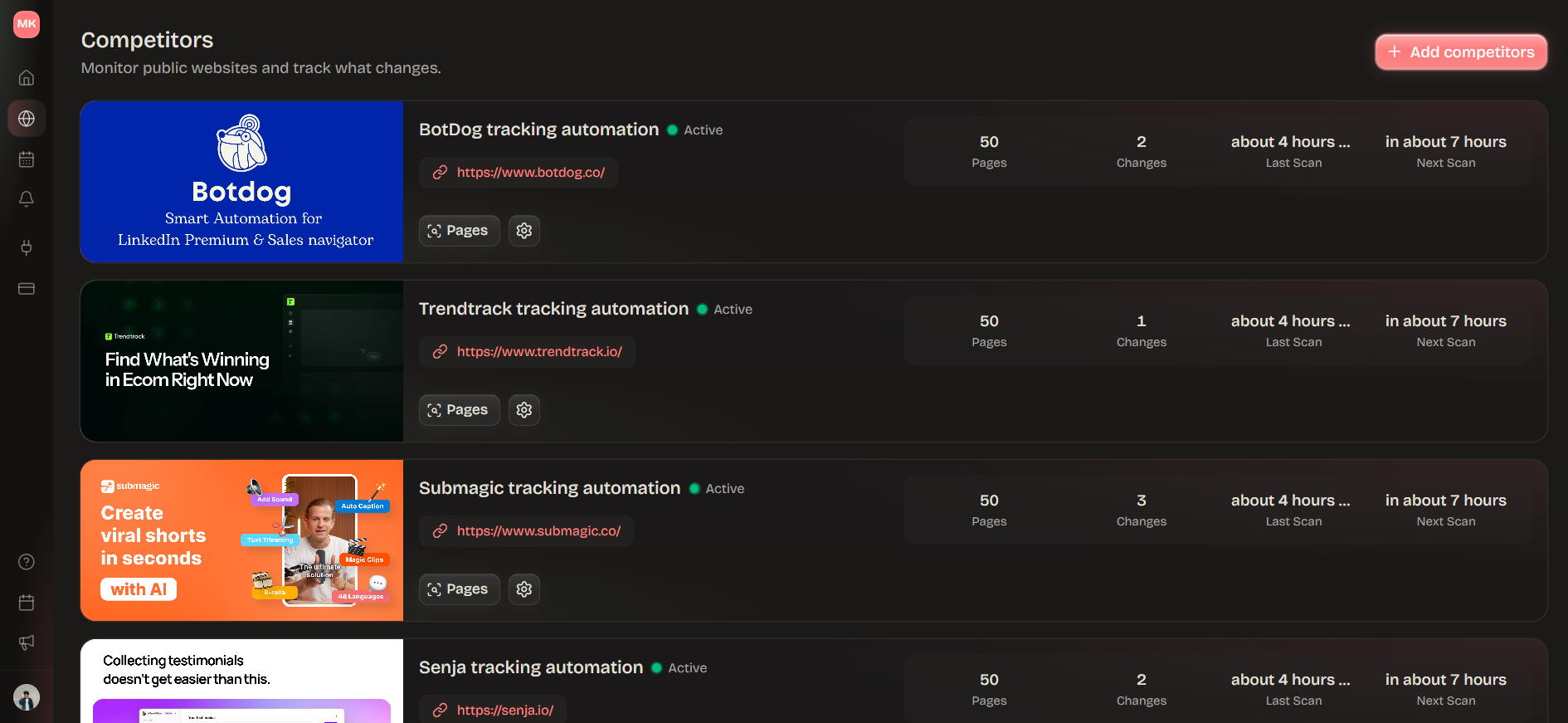
Ryvalise helps agencies centralize this collection and evidence layer while maintaining focused competitor workspaces for each account. Recurring website changes can become a client service instead of another manual research task.
Frequently asked questions
What is competitor monitoring for agencies?
Competitor monitoring for agencies is a managed service that repeatedly collects, verifies, and interprets public competitor changes for client decisions. It combines monitoring technology with account separation, analyst review, and scheduled delivery.
How many competitors should an agency monitor for each client?
Start with three to eight direct competitors plus a small lower-priority watchlist of emerging or adjacent threats. The right number depends on the client’s decision and the agency’s ability to verify the selected sources consistently.
Should clients receive every competitor alert?
No. Send immediate alerts only when a verified change meets an agreed urgency threshold. Group useful but non-urgent evidence into a weekly brief, and suppress cosmetic edits, duplicates, and weak signals.
Can one analyst manage competitor monitoring for many clients?
Yes, when collection, scoring, templates, and quality checks are standardized. Capacity should be measured by verification and analysis time rather than client count alone, because volatile markets and broad scopes require more review.
How do agencies prove the value of competitor monitoring?
Connect the service to decisions: sales responses updated, positioning tested, pricing reviewed, campaigns adjusted, customer questions investigated, or risks dismissed with evidence. Also report coverage, response time, and source quality so clients can see the reliability of the process.

Mehdi Khoudali
Founder, Ryvalise
Book a demo
Let’s make competitor monitoring useful for your team.
A relaxed 20-minute conversation to understand your workflow, show you Ryvalise, and answer anything before you get started.
We can talk about
- Your monitoring priorities
- Setting up your first competitor
- How alerts fit your workflow
Pick any time that works for you. You’ll get a calendar invite with the call details.