Market intelligence
Market Intelligence Tools
Compare market intelligence tools for competitor websites, search, company events, customer signals, and strategic research.
Market intelligence tools help teams understand competitors, customers, categories, and external forces that affect a business. The category includes website monitoring, SEO and traffic research, social listening, company databases, news aggregation, win-loss systems, and broader enterprise intelligence platforms.
Choosing market intelligence tools
Market intelligence tools should be chosen by the question, source class, and decision they support.
Choose by intelligence question
Market intelligence is not a single dataset. Start by naming the question: what changed on competitor websites, where does a rival win search demand, what are customers saying, which companies are hiring, or why are deals being won and lost?
| Question | Tool category |
|---|---|
| What did a competitor publish? | Website monitoring |
| Where do they get search visibility? | SEO intelligence |
| What is the market discussing? | Social listening |
| Which companies are moving? | Company and news data |
| Why do buyers choose? | Win-loss research |
| How do we activate findings? | CI and battlecards |
Website intelligence
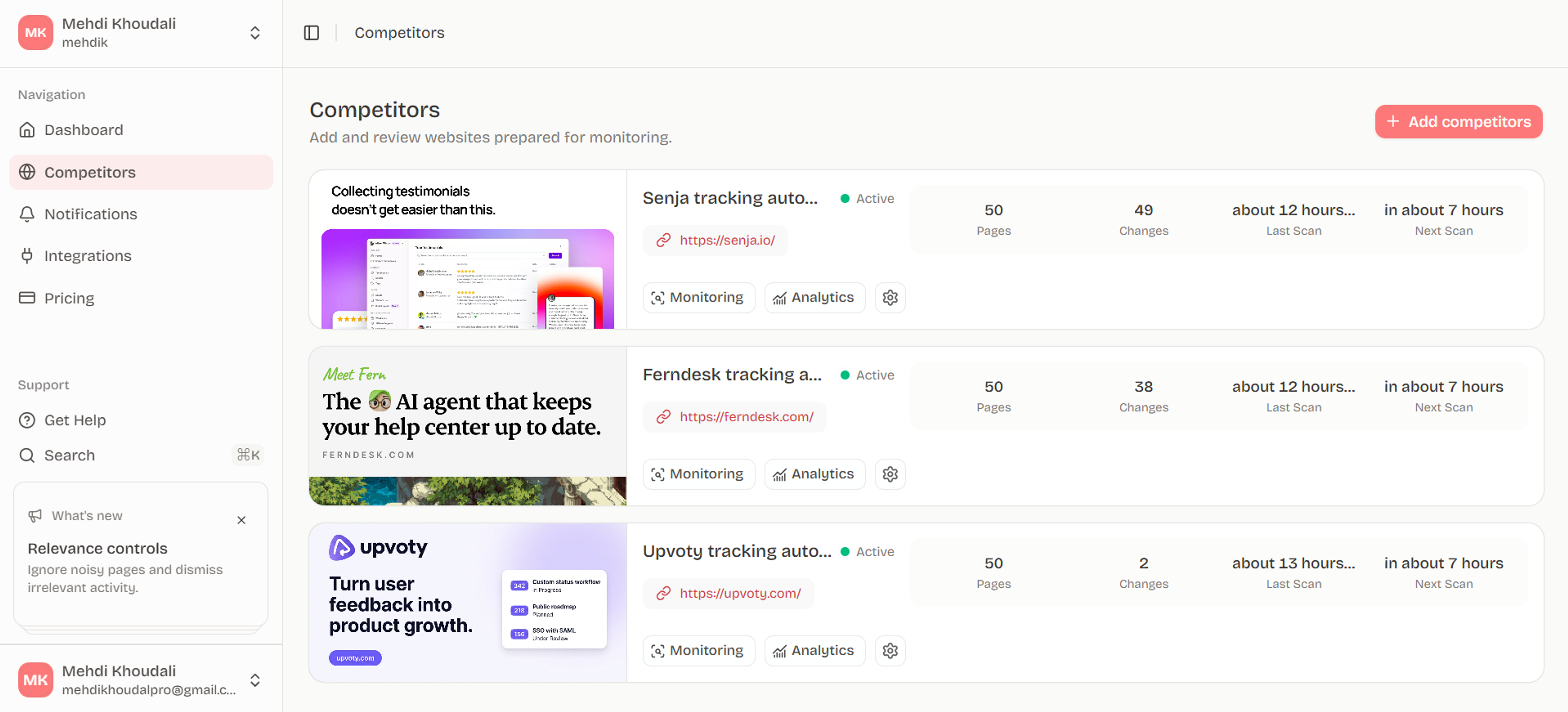
Competitor websites reveal product claims, pricing, packaging, positioning, proof, integrations, hiring themes, and conversion choices. Visualping, Distill.io, and changedetection.io are useful for monitoring individual pages or regions. Ryvalise is designed around competitor domains, page discovery, page types, stable monitoring, and source-backed activity summaries.
The main advantage of website monitoring is evidence. It can tell you what was publicly published and when. That makes it a useful foundation beneath broader market interpretation.
Search and traffic intelligence
Ahrefs, Semrush, SpyFu, Similarweb, and related products provide directional views into keywords, backlinks, paid search, traffic sources, audiences, and visibility. Use these products to discover topics and pages, benchmark a market, and form hypotheses.
Do not present estimated traffic or ranking data as a competitor’s private performance. Pair modeled signals with first-party pages and document the difference.
Company and conversation intelligence
News, funding, hiring, reviews, social, and community sources add context. They can reveal a launch, partnership, executive change, campaign, or emerging customer concern. Coverage varies by geography, source access, language, and classification, so record confidence and provenance.
Enterprise intelligence and activation
Crayon, Klue, and Kompyte focus on formal competitive intelligence and go-to-market activation. Their public product positioning emphasizes automated collection, summaries, battlecards, win-loss, importance, and integrations. These capabilities matter when many teams need current intelligence inside existing workflows.
Build a layered stack
Use one tool for the primary question, then add adjacent tools only when they provide distinct evidence. A practical stack might use Ryvalise for competitor website changes, an SEO platform for discovery, and customer or sales research for validation.
| Layer | Output | Review owner |
|---|---|---|
| Collection | Source and snapshot | Research or marketing ops |
| Classification | Signal type and confidence | Analyst |
| Interpretation | Possible implication | Subject-matter owner |
| Activation | Decision or play | Product, sales or marketing |
Governance matters
Set permissions, retention, source policies, and review ownership. Public data is not automatically accurate or complete. Avoid collecting private personal information, bypassing access controls, or hiding uncertainty behind an AI summary.
Build a source hierarchy
Treat sources as different evidence classes. First-party pages show what a company publishes. Customer interviews show buyer experience. Reviews show public opinions. SEO and traffic tools show modeled estimates. News and company data show external events. The hierarchy does not make one class universally better; it tells you what each class can support.
When writing a brief, label the source class beside the claim. This stops a traffic estimate from becoming “the competitor grew,” or a job posting from becoming “the competitor launched a new product.” The distinction improves trust and makes follow-up research more precise.
Plan the operating rhythm
Use daily collection for fast-moving pages, weekly synthesis for cross-source patterns, and monthly program review for coverage and ownership. Do not ask every stakeholder to inspect every source. Route only the signals that match their decisions.
Use a confidence ladder
Label findings as observed, corroborated, inferred, or unknown. Observed means a source directly shows the claim. Corroborated means more than one relevant source supports it. Inferred means the pattern suggests a possibility but does not prove intent. Unknown means the public evidence is insufficient.
This ladder is more useful than a single “insight” label because it tells the reader how much weight to place on the statement. It also gives the next researcher a clear path: find another source, run a customer check, or wait for the next page change.
Frequently asked questions
What are market intelligence tools?
They are software products that help teams collect and analyze information about markets, competitors, customers, and external events. The category spans specialized and enterprise tools.
What is the best market intelligence tool?
The best tool is the one that answers your highest-value question with trustworthy evidence and a workflow people use. A focused website monitor can be the right first step for competitor-page changes.
Are market intelligence tools accurate?
Accuracy depends on source coverage, collection method, freshness, classification, and the question. First-party page evidence is different from modeled traffic or sentiment estimates; document the distinction.
What is the difference between market and competitive intelligence?
Market intelligence covers the broader category, audience, and external environment. Competitive intelligence focuses more directly on specific competitors and decisions involving them. In practice, the workflows overlap.
How should a small team start?
Choose one decision, three to eight competitors, five to ten public sources, and a weekly review owner. Expand the stack only after the first workflow produces useful decisions.
Put the research into motion
Start with a clear public-signal layer so your market intelligence work stays current, sourced, and useful.
Start with Ryvalise