Competitive intelligence
How to Track Competitors
Learn how to track competitors with a focused system for websites, pricing, products, content, public signals, and team actions.
To track competitors effectively, choose the companies and signals that can affect a decision, automate recurring collection, and review changes on a consistent cadence. Start with a few high-signal website pages, then add SEO, social, company, or sales sources when they answer a distinct question.
How to track competitors without creating noise
To learn how to track competitors, begin with a small set of signals tied to decisions.
Step 1: Choose the competitor set
Create three groups: direct competitors with overlapping buyers, indirect alternatives that solve the same problem differently, and aspirational companies that reveal category or go-to-market patterns. Start with three to eight and record why each matters.
Step 2: Choose the signals
Track the sources where strategy becomes visible: homepage, pricing, product, comparison, integration, changelog, customer stories, content hubs, careers, social profiles, and company news. Choose based on the decision, not on a generic checklist.
| Goal | Signals |
|---|---|
| Pricing response | Plans, limits, discounts, billing, CTA |
| Product planning | Features, integrations, changelog |
| Positioning | Audience, category, promise, proof |
| Sales enablement | Comparisons, objections, customer stories |
| Market risk | Hiring, partnerships, news, policy |
Step 3: Define what counts as a change
Write rules before alerts arrive. A new plan, feature, integration, target segment, comparison claim, or top changelog entry can be meaningful. A rotating hero, cookie notice, old blog entry moved lower, or footer timestamp may not be.
Keep the evidence and hypothesis in separate fields. “The competitor added an enterprise plan” is a fact. “The competitor is moving upmarket” is a hypothesis that needs related evidence.
Step 4: Set priorities and cadence
Assign high, medium, or low importance to each source. High-impact pricing or launch pages can generate immediate review. Routine product or content changes can feed a daily digest. Weekly review should look for sequences across multiple pages.
Step 5: Use the right tool
Use page monitoring for public website changes, SEO tools for discovery and search estimates, social listening for public conversation, company databases for events, and CI software for enablement. The tool should preserve enough evidence for a reviewer to verify the signal.
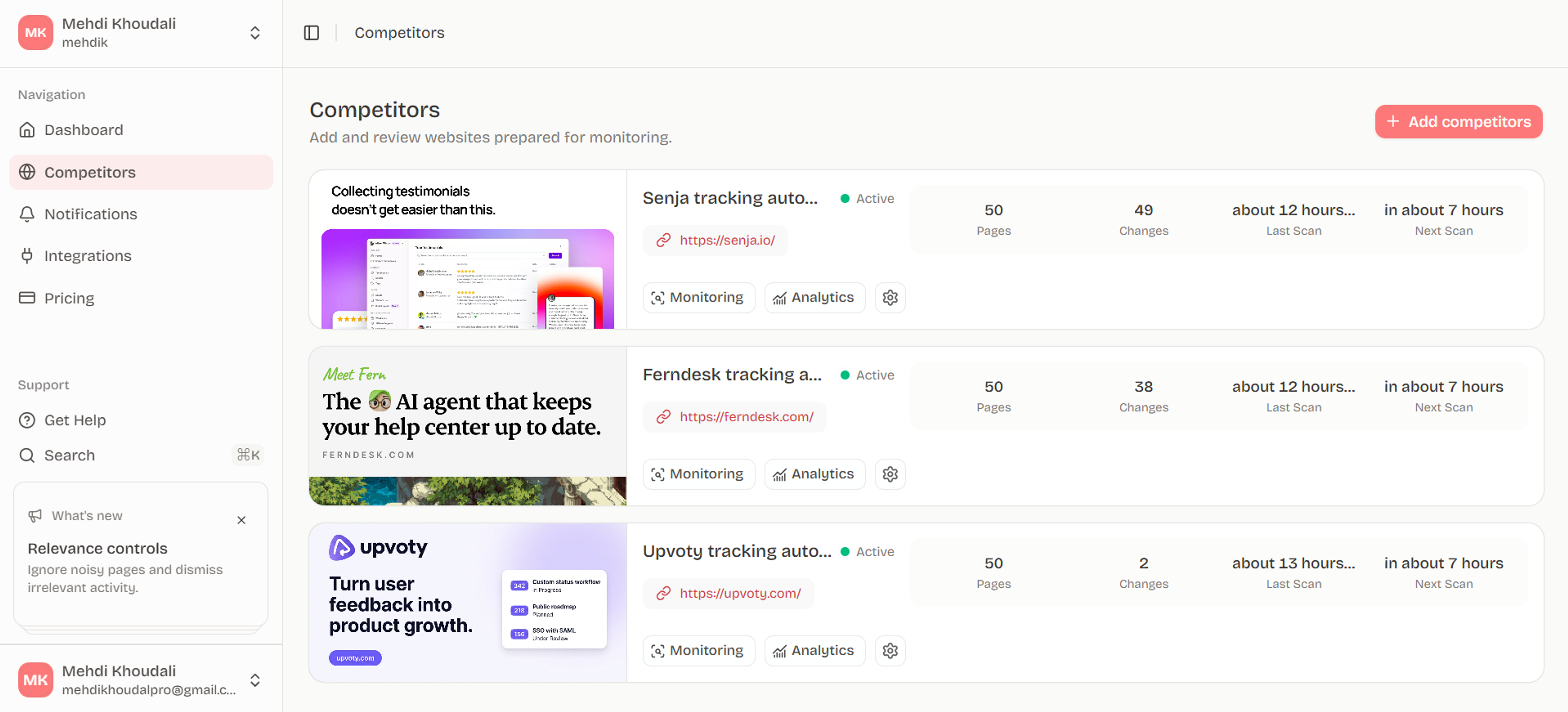
Ryvalise can serve as the website layer: bounded same-origin crawling, page discovery, page-type classification, stable-core selection, volatile-content handling, and concise source-backed activity summaries.
Step 6: Keep a decision log
For each meaningful signal, record the competitor, page type, URL, observation date, previous state, current state, confidence, owner, and next action. Use actions such as investigate, share, compare with your offer, update a battlecard, or archive.
Step 7: Tune the system
After a few cycles, measure useful-signal rate, false positives, review time, and decisions influenced. Promote pages that repeatedly matter. Lower the priority of sources that create noise. Keep manual overrides for launches and temporary strategic priorities.
Create an owner map
Tracking becomes useful when every signal has a destination. Assign pricing to product or finance, product changes to product marketing or product, proof and comparisons to sales enablement, and broader market events to strategy. One program owner should maintain the source list, but they do not need to interpret every signal.
Review the program with four metrics
Measure useful-signal rate, false-positive rate, time to review, and decisions influenced. These metrics are simple enough for a small team and reveal whether the system is improving. Add coverage and missed-change reviews when the program becomes more mature.
Do not use alert count as a success metric. A quiet system may mean that competitors did not change, the sources are stable, or the monitor is missing content. Check coverage and known changes separately.
Create an owner map
Tracking becomes useful when every signal has a destination. Assign pricing to product or finance, product changes to product marketing or product, proof and comparisons to sales enablement, and broader market events to strategy. One program owner should maintain the source list, but they do not need to interpret every signal.
Review the program with four metrics
Measure useful-signal rate, false-positive rate, time to review, and decisions influenced. These metrics are simple enough for a small team and reveal whether the system is improving. Add coverage and missed-change reviews when the program becomes more mature.
Do not use alert count as a success metric. A quiet system may mean that competitors did not change, the sources are stable, or the monitor is missing content. Check coverage and known changes separately.
Frequently asked questions
How do I track competitors for free?
Start with search, public websites, RSS, limited monitoring plans, and a simple evidence table. Free options often have limits, so keep the scope small and measure usefulness.
What should I track about my competitors?
Track pricing, product claims, positioning, comparisons, proof, integrations, content, hiring, partnerships, public conversation, and company events that map to a decision.
How often should competitors be tracked?
Collect high-signal pages according to consequence and volatility, then review routine changes daily or weekly. A slower review cadence can still use frequent collection.
How do I track competitor pricing?
Monitor plans, prices, billing units, usage limits, feature gates, discounts, FAQs, and purchase paths. Compare one normalized buyer scenario and label unknowns.
How do I stop competitor tracking from becoming noise?
Limit the competitor set, define page-specific change rules, filter volatility, assign priorities, group routine updates, and tune from decisions rather than alert volume.
Put the research into motion
Track the competitor signals that can change your next decision with a low-noise, source-backed Ryvalise workflow.
Start with Ryvalise