Sales enablement
How to Share Competitive Intelligence With Sales
Learn how to share competitive intelligence with sales through timely, source-backed briefs, battlecards, and deal-ready updates.

The best way to share competitive intelligence with sales is to turn verified competitor evidence into a short answer a rep can use in a live deal. That means delivering the right change, source, caveat, and response at the moment it matters—not forwarding a long research document and hoping someone finds the useful line.
Why competitive intelligence often fails to reach sales
Competitive intelligence usually fails in the handoff between research and a sales conversation. A team may have accurate notes in a shared drive, but a rep preparing for a call needs one verified point in seconds. Debriefing’s 2026 competitive enablement guide describes this as the gap between intelligence production and deal-level consumption: the bridge has to be designed, not assumed.
Three problems create most of the friction:
- Too much context: a report explains everything, while a rep needs the two facts relevant to this buyer.
- Unclear evidence: a claim has no source, date, or confidence, so sales cannot repeat it safely.
- Stale material: a static battlecard outlives the pricing page, product page, or competitor message it describes.
The answer is not to send more documents. Create a small set of formats with clear owners and delivery triggers.
Start with the sales question
Ask what sales is trying to decide before choosing a channel or template. Common questions include:
| Sales question | Useful output | Delivery moment |
|---|---|---|
| Is the competitor cheaper for this buyer? | Pricing comparison with plan limits and source dates | Before a pricing call |
| Did the competitor add the capability we lack? | Product-change brief with a neutral response | When a deal mentions the feature |
| How should we answer a competitor claim? | Battlecard objection and proof points | Before a competitive meeting |
| Is this competitor appearing more often? | Weekly competitor trend digest | Pipeline or forecast review |
Write the question at the top of the intelligence item. If the item cannot help a rep answer a real question, keep it in the research archive instead of pushing it into the sales channel.
Choose the right format
Sales does not need one universal document. Use the smallest format that solves the job.
Battlecards for repeatable situations
A battlecard is a compact reference for a known competitor. Salesforce’s current battlecard guidance frames it as a focused guide with the facts and responses a rep needs to counter a specific competitor. For the complete build, validation, and refresh workflow, use our guide to creating competitive battlecards that stay current.
Keep each battlecard scannable:
- When this competitor appears: the segment, use case, or buying signal.
- What they publicly claim: quote or paraphrase with a direct source link.
- What we can verify: the observed product, pricing, proof, or limitation.
- How to respond: a truthful sentence that connects to the buyer’s goal.
- What not to say: an unsupported assumption, insult, or outdated claim.
- Last checked and owner: a date and person responsible for review.
Do not turn a battlecard into a product brochure. The rep should be able to find the answer without reading an essay.
Deal briefs for one opportunity
Use a deal brief when the question is specific to an active opportunity. It can include the competitor page that matters, the buyer’s stated concern, two verified differences, one discovery question, and a suggested next step. Delete or archive the brief after the deal so temporary assumptions do not become permanent “facts.”
Digests for patterns
A digest is useful when several small signals form a pattern: repeated pricing changes, a new category page, or a run of product announcements. Keep the digest weekly or monthly, and link every item back to its source evidence. A digest should help a sales leader decide what deserves a battlecard update—not force every rep to read every change.
Build an evidence-first handoff
Sales can share a claim confidently when the evidence is easy to inspect. Use a consistent evidence block:
| Field | Example |
|---|---|
| Observation | Competitor moved API access to its Business plan |
| Source | Exact pricing or product URL |
| Checked | September 7, 2026 |
| Confidence | High: visible on the official pricing page |
| Caveat | Enterprise contracts may differ |
| Suggested response | Compare the buyer’s required workflow and total plan limits |
Keep the observation separate from the interpretation. “The page now lists API access on Business” is a fact. “They are pushing customers upmarket” is a hypothesis that needs more evidence. Google’s people-first guidance applies here too: useful content should be original, clear about sources, and honest about uncertainty.
Use a source hierarchy. Start with the competitor’s official product, pricing, changelog, documentation, and company pages. Then corroborate with reputable secondary sources or first-hand customer conversations. Sedulo’s guide to competitive intelligence for sales enablement emphasizes validation, source triangulation, and separating what is known from what is inferred.
Deliver intelligence where reps already work
The channel matters as much as the content. Match the delivery surface to the action:
- CRM or deal workspace: attach a deal brief to the opportunity so it remains with the buying context.
- Slack or Teams: post a short alert with the source link and an owner when a high-priority change appears.
- Enablement library: keep the canonical battlecard in one searchable location with a visible review date.
- Weekly meeting: review patterns, stale cards, and questions that reps could not answer.
Avoid publishing different versions in several places. If a rep finds an old PDF in a folder, trust falls quickly. Link every shared summary to one canonical record and show when it was last verified.
Set triggers and ownership
Define what should reach sales immediately and what belongs in a digest. A practical trigger model looks like this:
| Signal | Default treatment | Owner |
|---|---|---|
| Pricing, packaging, or plan-limit change | Same-day alert and battlecard review | Product marketing |
| New feature or integration page | Alert if it affects an active segment; otherwise weekly digest | Product marketing and product |
| New customer proof or comparison claim | Add to the relevant card after verification | Enablement |
| Blog post or hiring page | Digest unless it changes a sales conversation | CI or marketing |
| Unverified social claim | Research queue, not a sales alert | CI |
The owner is responsible for verification, not just forwarding. Give every card an expiry or review date. A “last checked” label is more useful than a vague promise that the material is current.
Measure adoption without overclaiming impact
Track whether the intelligence is reaching and helping sales before claiming it changed revenue. Start with operational measures:
- battlecard views and searches;
- time from a competitor change to a published update;
- percentage of cards reviewed before their expiry date;
- questions or objections answered using a source-backed item;
- rep feedback on usefulness and missing context.
Then connect those measures to deal outcomes carefully. Compare competitive win rates, sales-cycle length, and discounting in periods with consistent adoption, but do not claim that one alert caused a win. There are too many other variables. Debriefing’s sales-team playbook recommends measuring distribution and adoption alongside business outcomes so the team can see where the handoff is breaking.
If nobody opens a card, investigate its format, timing, and relevance before producing more content. If reps open it but still ask the same question, improve the answer or the evidence rather than adding another channel.
A repeatable weekly workflow
Use this six-step loop to keep competitive intelligence useful:
- Collect: monitor the pages and sources tied to current sales questions.
- Verify: check the current page, previous state, date, and source quality.
- Prioritize: route high-impact changes to an owner; group low-impact items in a digest.
- Translate: write the observation, caveat, discovery question, and neutral response.
- Deliver: publish one canonical item and share a short pointer where reps work.
- Learn: record feedback, usage, and unanswered questions for the next review.
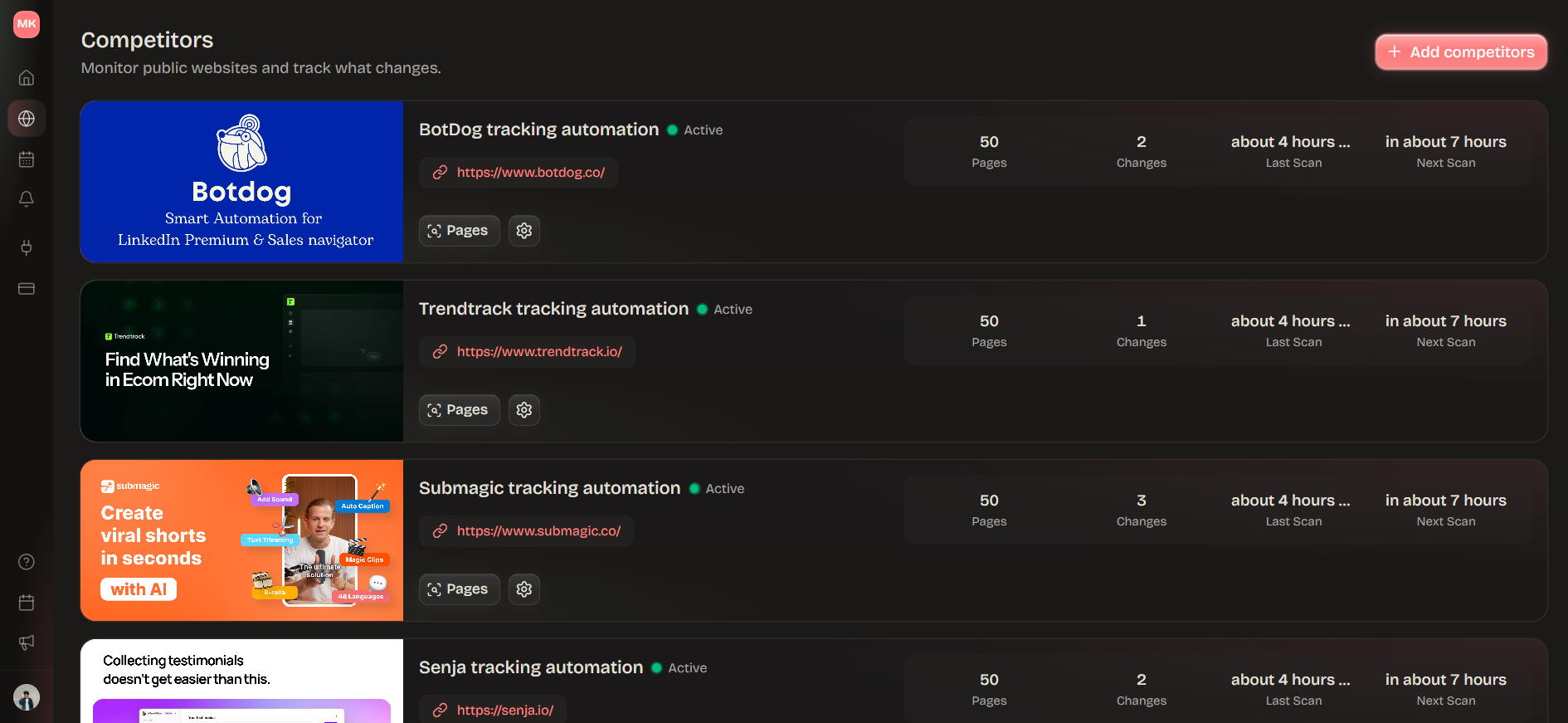
Ryvalise supports the collection and verification layer by discovering relevant competitor pages, preserving page history, and surfacing meaningful changes with source evidence. Your enablement process turns that evidence into a decision a rep can use.
Frequently asked questions
What is the best way to share competitive intelligence with sales?
Share a short, source-backed answer in the channel sales already uses, then link to one canonical battlecard or deal brief. Include the observation, date, confidence, caveat, and suggested response.
Should every competitor change be sent to sales?
No. Send pricing, packaging, product, and proof changes when they affect a segment or active deal. Put routine blog, hiring, and low-impact copy changes in a digest or research archive.
Who should own competitive intelligence for sales?
Product marketing or a competitive-intelligence owner should verify and maintain the source record. Sales enablement should own discoverability and training, while product and sales contribute questions and feedback.
How often should battlecards be updated?
Review a card whenever a high-impact source changes, and set a regular expiry review—monthly is a practical starting point for active competitors. Show the last-checked date so reps can judge freshness.
How can I tell whether sales uses competitive intelligence?
Measure views, searches, feedback, update speed, and questions answered first. Correlate those measures with deal outcomes only as directional evidence, not proof that one item caused a win.

Mehdi Khoudali
Founder, Ryvalise
Book a demo
Let’s make competitor monitoring useful for your team.
A relaxed 20-minute conversation to understand your workflow, show you Ryvalise, and answer anything before you get started.
We can talk about
- Your monitoring priorities
- Setting up your first competitor
- How alerts fit your workflow
Pick any time that works for you. You’ll get a calendar invite with the call details.