Competitive intelligence
How to Do a Competitor Analysis
Learn how to do a competitor analysis with a repeatable process for research, comparison, evidence, interpretation, and action.
To do a competitor analysis, define the decision, choose relevant competitors, collect comparable evidence, identify meaningful differences, and turn the findings into owned actions. A good analysis is not a list of features; it is a dated explanation of how another company serves a buyer and what your team should consider next.
How to do a competitor analysis that leads to action
To learn how to do a competitor analysis well, start with the decision and work backward to the evidence.
Step 1: Start with a decision
Decide whether the analysis will support positioning, pricing, product planning, sales enablement, market entry, or an investment decision. The question determines the sources and the level of detail.
| Decision | Evidence to collect |
|---|---|
| Positioning | Homepage, solutions, category language |
| Pricing | Plans, limits, billing and CTAs |
| Product | Product, feature and integration pages |
| Sales | Comparison pages, proof and objections |
| Market entry | Segments, geography, partnerships |
Step 2: Select the competitor set
Choose direct, indirect, and aspirational competitors. Direct competitors overlap in buyer and problem. Indirect competitors solve the problem differently. Aspirational competitors provide category or go-to-market context.
Start with three to eight. Write one sentence explaining why each belongs. Remove companies that cannot influence the decision; a long list makes the final comparison harder to use.
Step 3: Build a comparison schema
Use the same fields for every company, but do not force false equivalence. Record audience, problem, offer, price, limits, proof, integrations, buying motion, differentiators, and risks. Add a source URL and observation date to each meaningful claim.
Keep displayed facts separate from your interpretation. A page can say “contact sales” without proving a company has abandoned self-serve. A feature can be listed without proving product maturity.
Step 4: Collect first-party evidence
Begin with official websites and public documentation. Review the homepage, pricing, product, comparison, integration, customer-story, changelog, blog, careers, and legal pages that match the decision. Use third-party reviews and SEO estimates as context, not as substitutes for the company’s own published offer.
Step 5: Compare scenarios, not slogans
For pricing, choose one buyer scenario and normalize the unit, seats, usage, currency, billing period, required feature, and sales involvement. For product, compare the capability and outcome a buyer can verify. For positioning, compare audience, category, promise, proof, and CTA.
Step 6: Identify the meaningful difference
Rank differences by consequence, confidence, and actionability. A meaningful difference can be a plan boundary, a missing integration, a new target segment, a repeated proof claim, or a change in purchase path. A visual redesign may matter less unless it changes conversion or message clarity.
Step 7: Write findings as fact and interpretation
Use a two-column discipline. The fact states what the source publishes. The interpretation states what it may mean and how confident you are. Include alternative explanations when the evidence is thin.
Step 8: Turn findings into actions
Every finding should have an owner and next step: update a battlecard, validate a product gap, test a message, review pricing, ask sales for evidence, or monitor the competitor for confirmation. If no action follows, the finding may not be important enough for the report.
Step 9: Keep the analysis current
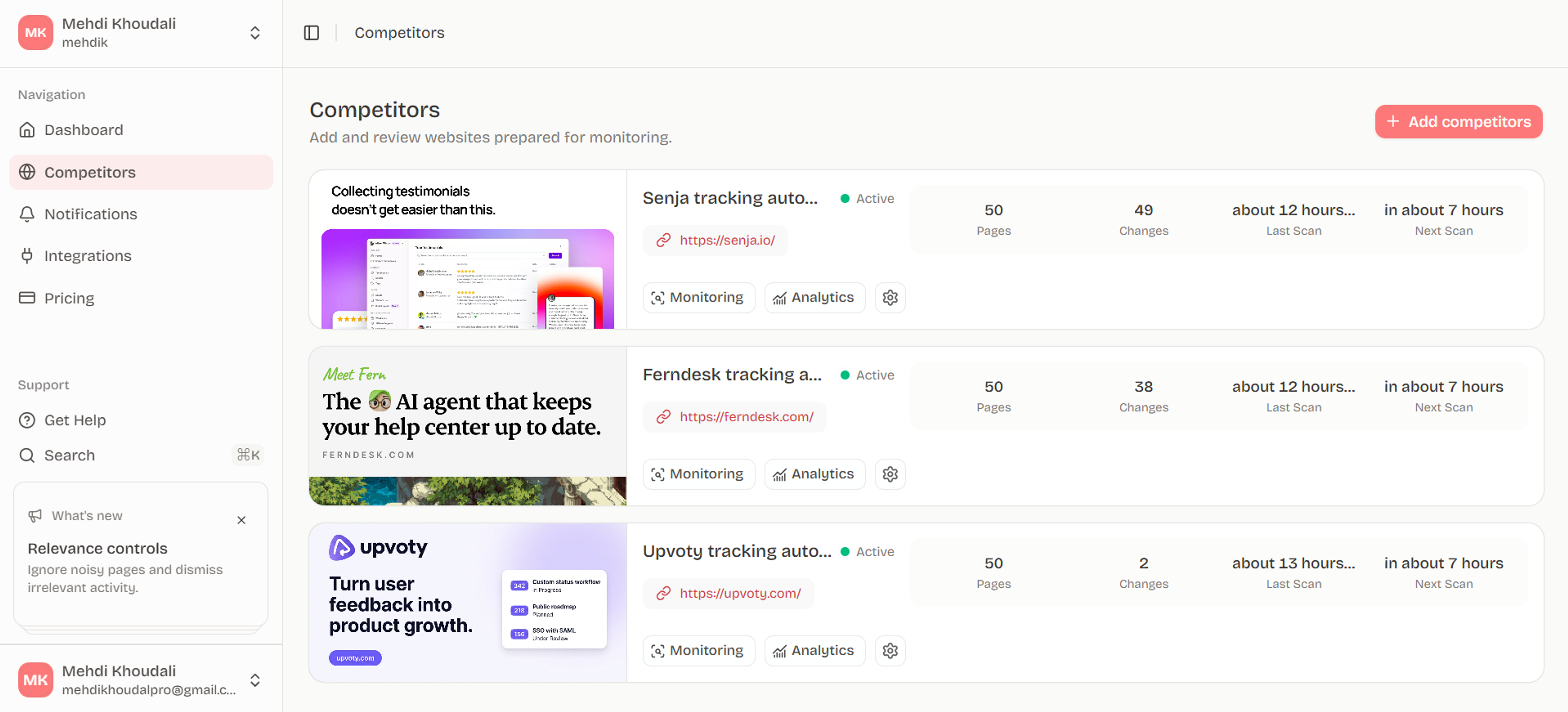
An analysis is a snapshot; a monitoring workflow turns it into a living view. Recheck high-consequence pages, watch for new pages and entries, and record changes over time. Ryvalise can automate this evidence layer so the next analysis starts from current material.
Use a repeatable evidence table
This format makes the analysis reviewable. Anyone can see what was observed, what remains a hypothesis, and who is responsible for deciding the next step. It also prevents a polished narrative from hiding missing sources.
| Finding | Observation | Interpretation | Owner |
|---|---|---|---|
| Pricing | Public plan limit changed | Check scenario impact | Pricing |
| Product | New integration page appeared | Validate customer relevance | Product |
| Positioning | Audience language shifted | Test with customer language | PMM |
| Proof | New outcome claim published | Verify source and sales use | Sales |
Refresh the analysis without starting over
Keep the stable company context separate from changing evidence. The category, audience, and core offer may need occasional review; pricing, product, comparisons, and content can change weekly. A monitoring system such as Ryvalise can keep those high-signal pages current so the analyst spends time on interpretation rather than repeated copying.
Use a repeatable evidence table
This format makes the analysis reviewable. Anyone can see what was observed, what remains a hypothesis, and who is responsible for deciding the next step. It also prevents a polished narrative from hiding missing sources.
| Finding | Observation | Interpretation | Owner |
|---|---|---|---|
| Pricing | Public plan limit changed | Check scenario impact | Pricing |
| Product | New integration page appeared | Validate customer relevance | Product |
| Positioning | Audience language shifted | Test with customer language | PMM |
| Proof | New outcome claim published | Verify source and sales use | Sales |
Refresh the analysis without starting over
Keep the stable company context separate from changing evidence. The category, audience, and core offer may need occasional review; pricing, product, comparisons, and content can change weekly. A monitoring system such as Ryvalise can keep those high-signal pages current so the analyst spends time on interpretation rather than repeated copying.
Frequently asked questions
How long does a competitor analysis take?
A focused analysis of three to five competitors can take a few hours when the decision and schema are clear. A broad market study takes longer. Automation reduces recurring collection but does not remove the need for judgment.
What is the first step in competitor analysis?
The first step is defining the decision the analysis must support. Without that, the team collects too much information and struggles to rank what matters.
What data should I collect about competitors?
Collect audience, problem, product, pricing, proof, integrations, buying motion, positioning, changes, and sources. Use fields that map to your decision.
What is the difference between competitor analysis and SWOT?
Competitor analysis compares external companies and evidence. SWOT is a broader framework for strengths, weaknesses, opportunities, and threats. Competitor research can provide inputs to a SWOT but is not the same exercise.
How often should competitor analysis be repeated?
Repeat the structured analysis when strategy or market conditions change, and maintain the underlying evidence continuously or on a regular review cadence.
Put the research into motion
Turn one competitor analysis into a living system that keeps your evidence current in Ryvalise.
Start with Ryvalise