Tool comparison
Crayon Alternatives
Compare Crayon alternatives for website monitoring, competitive intelligence, pricing changes, battlecards, and sales enablement.
Crayon alternatives are worth evaluating when you need a lighter website-monitoring workflow, a different sales-enablement model, a self-hosted option, or a more focused way to track competitor pages. Crayon positions itself as a competitive intelligence platform with automated monitoring, AI summaries, importance scoring, and activation for go-to-market teams.
Choosing Crayon alternatives
Crayon alternatives should be compared by operating model, evidence quality, and team fit.
Why teams compare Crayon alternatives
An enterprise CI suite can be a strong fit when a company has dedicated analysts, battlecards, sales integrations, and a formal adoption program. It can be more than a small team needs when the first job is simply to know when a competitor changed pricing, a product page, or a comparison page.
Define the gap before you compare vendors. Common gaps include implementation weight, budget, page-level evidence, self-serve access, whole-site discovery, workflow speed, and a need to keep observation separate from interpretation.
| Need | Alternative direction | Best question |
|---|---|---|
| Website evidence | Ryvalise or page monitor | What changed and where? |
| Sales enablement | Klue or Kompyte | Will sellers use the guidance? |
| Flexible technical setup | changedetection.io | Can the team operate it? |
| Search research | Ahrefs or Semrush | Where does the competitor rank? |
| Broader market signals | Market-intelligence platform | What is changing outside the site? |
Klue
Klue combines competitive intelligence and win-loss programs in one platform. Its public positioning emphasizes deal-based insights, a sales assistant, workplace integrations, and buyer feedback. Consider it when you need competitor intelligence joined closely to sales outcomes and win-loss analysis.
The comparison is about operating model, not only features. If your team has enough deal volume and ownership to maintain a formal program, this breadth can be valuable. If not, begin with the public evidence that sales and product teams already need.
Kompyte
Kompyte emphasizes automated collection across websites, reviews, content, social, ads, and job postings, with AI filtering and battlecards. It suits teams that want broad signal coverage connected to sales workflows.
During evaluation, test whether the system surfaces the few signals your team can act on rather than simply increasing collection volume. Ask how source evidence is retained and how a reviewer can audit a summary.
Ryvalise
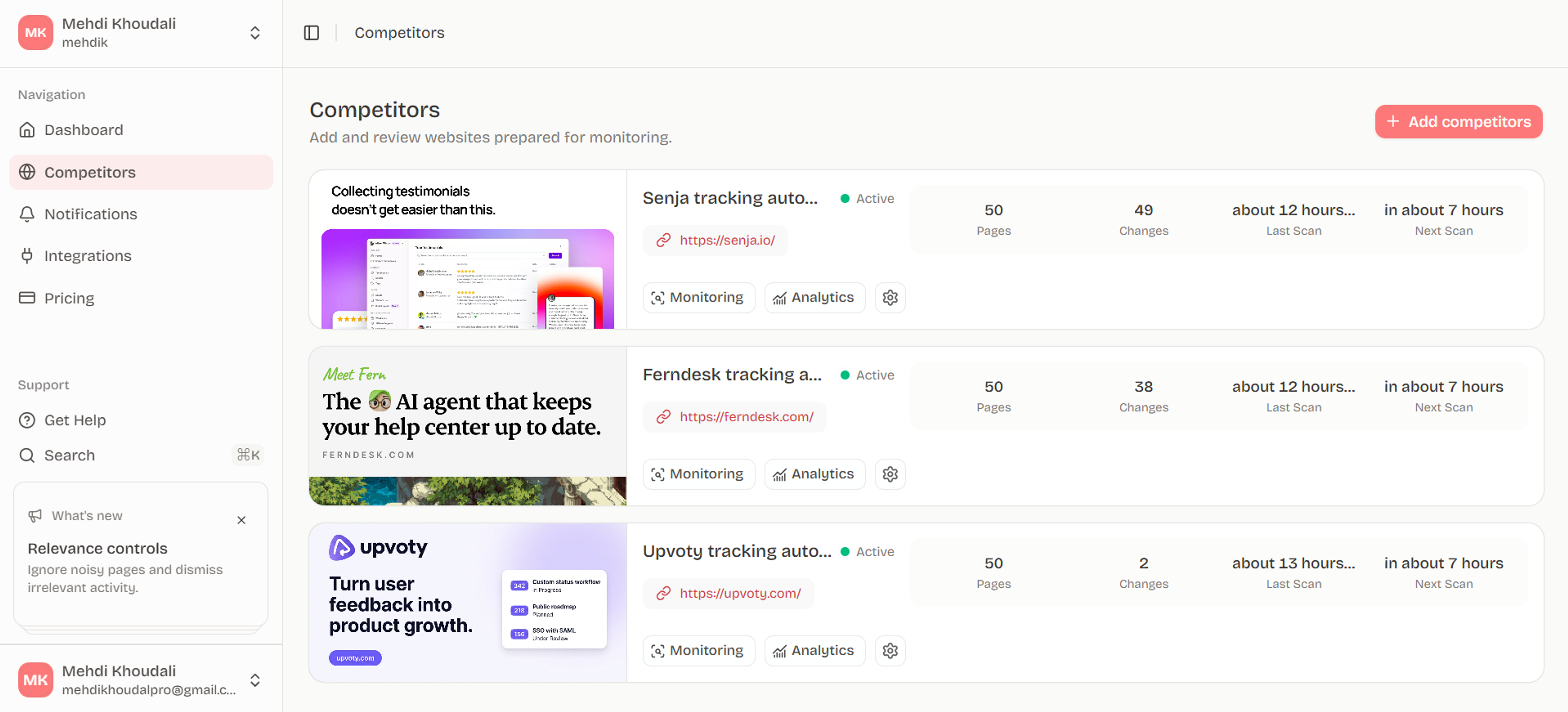
Ryvalise is a Crayon alternative for teams that want a focused competitor-website intelligence layer. It crawls same-origin pages within a bounded budget, classifies page types, preserves manual choices, prioritizes high-signal pages, and keeps source changes separate from downstream AI analysis.
That focus is useful when the decision starts with public website movement: price, packaging, product, positioning, proof, comparisons, integrations, and launches. It also creates a clean base for adding broader market or sales data later.
changedetection.io and page monitors
changedetection.io provides flexible monitoring, targeted elements, browser steps, filters, and many notification formats. Lightweight tools such as Distill.io and Visualping are useful when you already know the exact pages or regions to watch.
The tradeoff is context. A single-page monitor may alert you precisely but leave the analyst to discover related pages and interpret the sequence. A broader CI suite may provide more activation but require more program design.
A fair Crayon-alternative test
Use the same competitors and five page types. Score evidence quality, discovery, noise control, history, routing, and total review time. Then run one real decision through the workflow, such as preparing for a pricing review or sales enablement meeting.
Compare operating models, not only features
Crayon, Klue, and Kompyte are usually evaluated as program platforms, while page monitors are often evaluated as collection utilities. They answer different organizational needs. A program platform may be valuable because it gives sellers a current battlecard and gives leaders adoption reporting. A focused monitor may be valuable because a small team can deploy it today and inspect source evidence without a large rollout.
Ask who owns the system after purchase. Include analyst time, page configuration, taxonomy maintenance, integrations, user training, and review meetings in the comparison. A lower subscription price is not automatically lower total cost if the team must build and operate the missing workflow.
A practical migration path
Start with the public website evidence that sales and product teams already request. Establish a change log and a review cadence. When the team can show which signals influence decisions, add battlecards, win-loss, or broader market data. This sequence preserves momentum and gives an enterprise purchase a clearer business case.
Keep the first use case narrow
The fastest way to compare alternatives is to choose one real use case, such as keeping pricing and product evidence current for a sales review. Define the pages, owners, alert cadence, and output before looking at a vendor demo. This prevents broad feature lists from hiding the work your team actually needs.
After the first use case works, expand to comparisons, integrations, customer proof, and external sources. A narrow win creates a better foundation for a broader CI program than a large implementation with no adopted review habit.
Frequently asked questions
What are the best Crayon alternatives?
Klue and Kompyte are broad competitive intelligence alternatives. Ryvalise, Visualping, Distill.io, and changedetection.io are more focused options for website changes. Ahrefs and Semrush address SEO intelligence rather than the same full CI job.
Is there a cheaper alternative to Crayon?
Pricing varies by scope and contract, so verify current quotes. A focused page-monitoring workflow may cost and take less to operate than a full enterprise CI program when your initial need is website evidence.
Which Crayon alternative is best for pricing changes?
Choose a tool that monitors rendered pricing content, limits, plans, and purchase paths while preserving before-and-after evidence. Ryvalise is designed around that competitor-website use case.
Does Klue replace Crayon?
They overlap as competitive intelligence platforms, but their product emphasis and workflows differ. Compare the exact sources, enablement, win-loss, integrations, and ownership model your team needs.
Should a startup buy enterprise CI software?
Only when the team has a clear program owner, enough recurring decisions, and a workflow that will be used. A smaller evidence-first system can establish the habit before adding enterprise breadth.
Put the research into motion
Start with the evidence layer your team needs, then expand into broader competitive intelligence when the workflow proves valuable.
Start with Ryvalise