Competitive intelligence
Competitor Tracking Tools
Compare competitor tracking tools for websites, SEO, pricing, social signals, company events, and sales workflows.
Competitor tracking tools help teams watch recurring changes in competitor websites, search visibility, pricing, social conversation, company events, or sales evidence. The best tool is determined by the signal you need and the workflow that turns it into action.
Choosing competitor tracking tools
Competitor tracking tools should map directly to the sources and decisions your team owns.
Competitor tracking categories
Website tools capture public page changes. SEO tools estimate keywords, rankings, links, and paid search. Social tools monitor mentions and sentiment. Market tools aggregate news, company, and funding events. Enterprise CI platforms organize intelligence for battlecards and go-to-market teams.
| Tracking job | Useful output |
|---|---|
| Website changes | Before-and-after page evidence |
| Pricing movement | Plans, prices and limits |
| SEO movement | Rankings and content gaps |
| Social movement | Mentions and conversation |
| Company events | News, funding and hiring |
| Sales enablement | Battlecards and guidance |
Track websites first
Website pages are where competitors make many commercial and product choices public. Monitor the homepage, pricing, product, comparison, integration, customer-story, changelog, and content hubs. Choose page importance based on the decision: a pricing page may be high priority for growth but not for engineering.
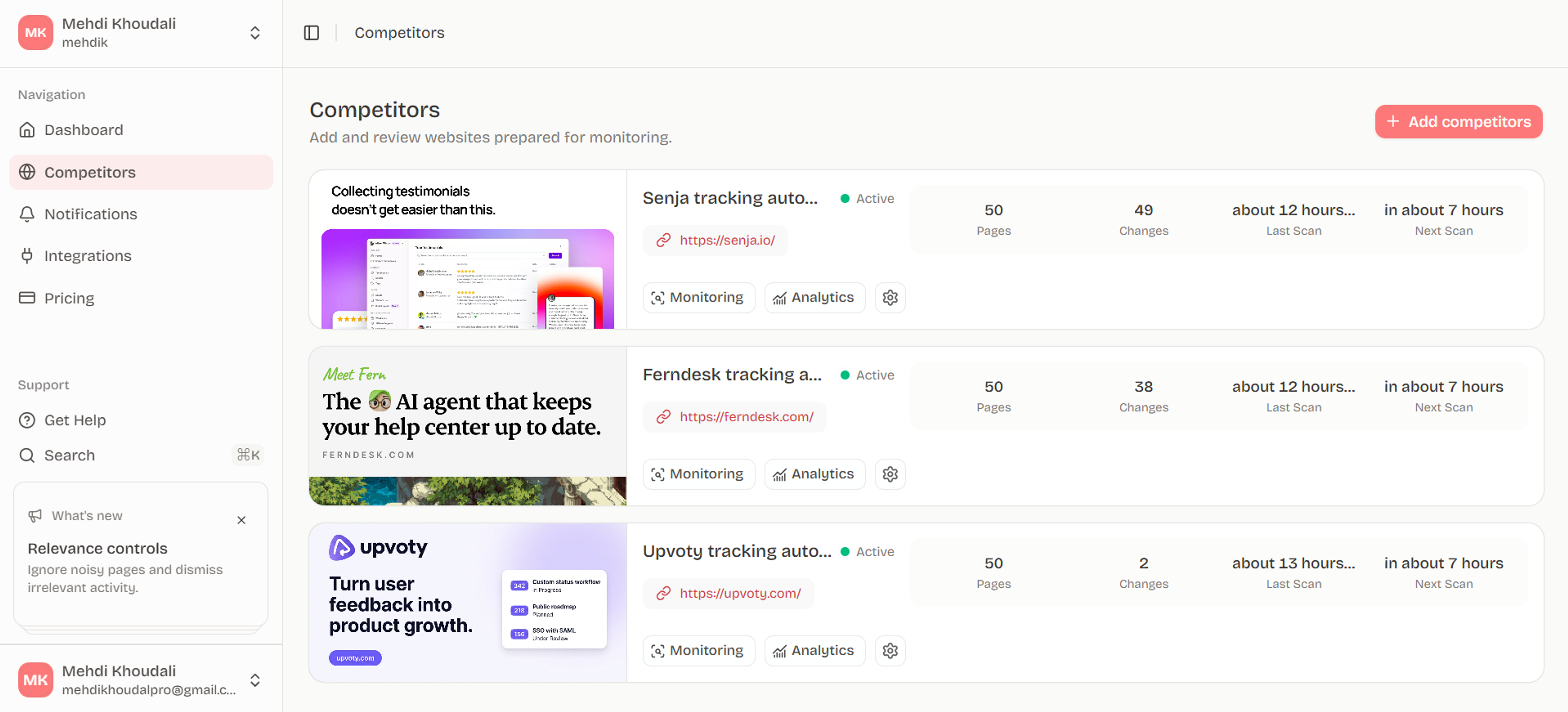
Visualping, Distill.io, and changedetection.io are useful for individual page monitoring. Ryvalise adds competitor-specific discovery, page-type classification, stable-core selection, and activity summaries so teams can see related website changes across a domain.
Use SEO tools for discovery
Ahrefs, Semrush, SpyFu, and similar platforms help identify competing domains, ranking pages, keywords, and backlinks. Use those estimates to find pages worth watching, then verify important conclusions against first-party sources.
An SEO visibility change may be caused by algorithm updates, seasonality, links, or content changes. It is a lead for investigation, not direct evidence of a strategic decision.
Add social and company signals carefully
Social listening can show public conversation, sentiment, and campaign reach. News and company databases can show funding, leadership, and hiring events. These sources add context, but each has coverage and classification limits. Record the source and confidence level.
Build a tracking workflow
Define the competitor set, source list, meaningful-change rules, owner, cadence, and delivery channel. Immediate alerts should be reserved for high-consequence signals. Daily or weekly digests are better for routine movement. Review the program monthly and remove sources that never influence a decision.
| Workflow stage | Key question |
|---|---|
| Scope | Which competitors can affect our work? |
| Collect | Can the source be checked reliably? |
| Classify | What type of signal is it? |
| Review | Is the evidence enough to act? |
| Learn | Did the signal change a decision? |
Use a shared signal taxonomy
Create a small taxonomy such as commercial, product, positioning, proof, conversion, discovery, and company signal. Add a confidence field and a consequence field. This gives product, marketing, sales, and strategy a common language while allowing each team to filter for its own decisions.
Do not let the taxonomy become a second reporting burden. If a reviewer cannot classify a change quickly, add an unknown option and revisit the categories later. The purpose is routing and prioritization, not perfect academic labeling.
Review sources as sequences
Track repeated changes in the same area. A new comparison page followed by a pricing change and a new customer story can deserve more attention than any one event. Preserve the order and dates, then state the pattern as a hypothesis. This makes competitor tracking useful for planning without pretending to reveal private intent.
Separate collection from distribution
The best tracking tool is not necessarily the one with the biggest dashboard. Collection answers whether the signal was captured. Distribution answers whether the right person received it in a usable format. Decision support answers whether anything changed afterward.
Test these stages separately. A tool can be excellent at collecting pages and poor at routing them. Another can produce polished battlecards but depend on stale manual inputs. A transparent workflow makes the gap visible and gives you a better reason to add or replace a tool.
Frequently asked questions
What are competitor tracking tools?
They are tools that monitor recurring public signals about competitors, including website changes, search visibility, prices, mentions, company events, and sales intelligence.
What is the best competitor tracking tool?
Choose by signal. Ryvalise is focused on competitor websites; SEO platforms are strong for search discovery; social and market platforms cover other public signals; CI suites support formal enablement programs.
How many competitors should I track?
Start with three to eight competitors tied to an active decision. Expand only when an additional company adds distinct, useful context.
How do I track competitor pricing?
Monitor pricing pages, feature matrices, FAQs, and purchase routes. Normalize one scenario and record plan, unit, limits, billing, discounts, and unknowns.
How do I know whether a tracking alert matters?
Check consequence, confidence, and actionability. Review the source evidence, look for corroborating pages, and label hypotheses separately from facts.
Put the research into motion
Start tracking competitors around the pages and signals that can change your next product, marketing, or sales decision.
Start with Ryvalise