Competitive intelligence
Competitor Analysis Tools
Compare competitor analysis tools by data coverage, alerts, workflow fit, and the quality of evidence they give your team.
Competitor analysis tools help teams collect, compare, and interpret public signals about other companies. The right choice depends on whether you need website change alerts, SEO data, social listening, traffic estimates, sales battlecards, or a repeatable research workflow.
Choosing competitor analysis tools
Competitor analysis tools should be selected by the decision they support and the evidence they preserve.
What competitor analysis tools actually do
The category is broad. Some products crawl competitor websites and show before-and-after changes. Others estimate search visibility, map backlinks, track social mentions, or organize intelligence for sales. A tool is useful only when its data answers a decision your team already needs to make.
Start with the decision rather than the feature list. A product marketer may need to know when a rival changes positioning or launches a feature. A sales team may need current objection handling. An SEO team may need keyword gaps and new competitor pages. These are related jobs, but they require different evidence.
| Tool category | Best for | Typical evidence |
|---|---|---|
| Website monitoring | Pricing, messaging, product and page changes | Before-and-after page evidence |
| SEO intelligence | Keywords, rankings and backlinks | Search visibility estimates |
| Social listening | Mentions, sentiment and share of voice | Posts and media mentions |
| Sales enablement | Battlecards and objection handling | Curated internal guidance |
| Market intelligence | Company, funding and category signals | News and company data |
Website monitoring versus competitor research
Website monitoring answers “what changed?” It watches selected URLs, extracts rendered content, compares versions, and alerts you when a meaningful difference appears. Visualping emphasizes highlighted screenshots and AI-assisted importance; Distill.io emphasizes selected page elements, cloud checks, and history; changedetection.io combines targeted monitoring, browser steps, and many notification formats.
Competitor research answers a wider question: how does the market work, and what should we do? It may include pricing, customer proof, hiring, integrations, search visibility, and product announcements. A monitoring tool becomes more valuable when it preserves the source page and the exact evidence instead of sending only a vague “page changed” notification.
SEO tools and traffic tools solve a different problem
Semrush, Ahrefs, Similarweb, and SpyFu are often included in competitor tool lists, but they do not measure the same thing. SEO platforms estimate search demand, rankings, paid search, and links. Traffic platforms estimate audience and channel mix. Those are valuable directional signals, yet they should not be presented as a direct record of what a competitor changed on its website.
Use SEO data to discover pages and topics worth watching. Use page monitoring to verify the public change. Then put both in a dated research record so your conclusion distinguishes observed evidence from an estimate.
What to compare before choosing a tool
Evaluate the complete path from collection to action. Ask how a tool discovers pages, handles JavaScript, deduplicates repeated renders, preserves history, and lets you suppress volatile regions. Then inspect how it routes alerts and whether a reviewer can reach the original source quickly.
- Coverage: selected pages, whole domains, social sources, ads, jobs, or search results.
- Change quality: raw pixels, text, DOM regions, semantic page types, or an AI summary.
- Context: timestamp, URL, changed section, previous version, and source link.
- Workflow: email, Slack, Discord, webhook, CRM, battlecard, or weekly brief.
- Control: page importance, ignored regions, notification cadence, and team ownership.
- Commercial fit: transparent self-serve pricing, usage limits, seats, and export rules.
A practical shortlist by team need
For a large competitive-intelligence program, Crayon, Klue, and Kompyte are designed around collecting signals and activating them in sales or go-to-market workflows. Their official positioning focuses on automated intelligence, battlecards, summaries, and enablement.
For lightweight page monitoring, Visualping, Distill.io, and changedetection.io are easier starting points. They are useful when your first question is whether a specific pricing page, product page, policy, or public announcement changed.
For a mixed research stack, pair one SEO discovery platform with one evidence-preserving website monitor. This usually gives a cleaner operating model than asking a single tool to be equally strong at rankings, page diffs, social listening, and sales enablement.
How Ryvalise fits the gap
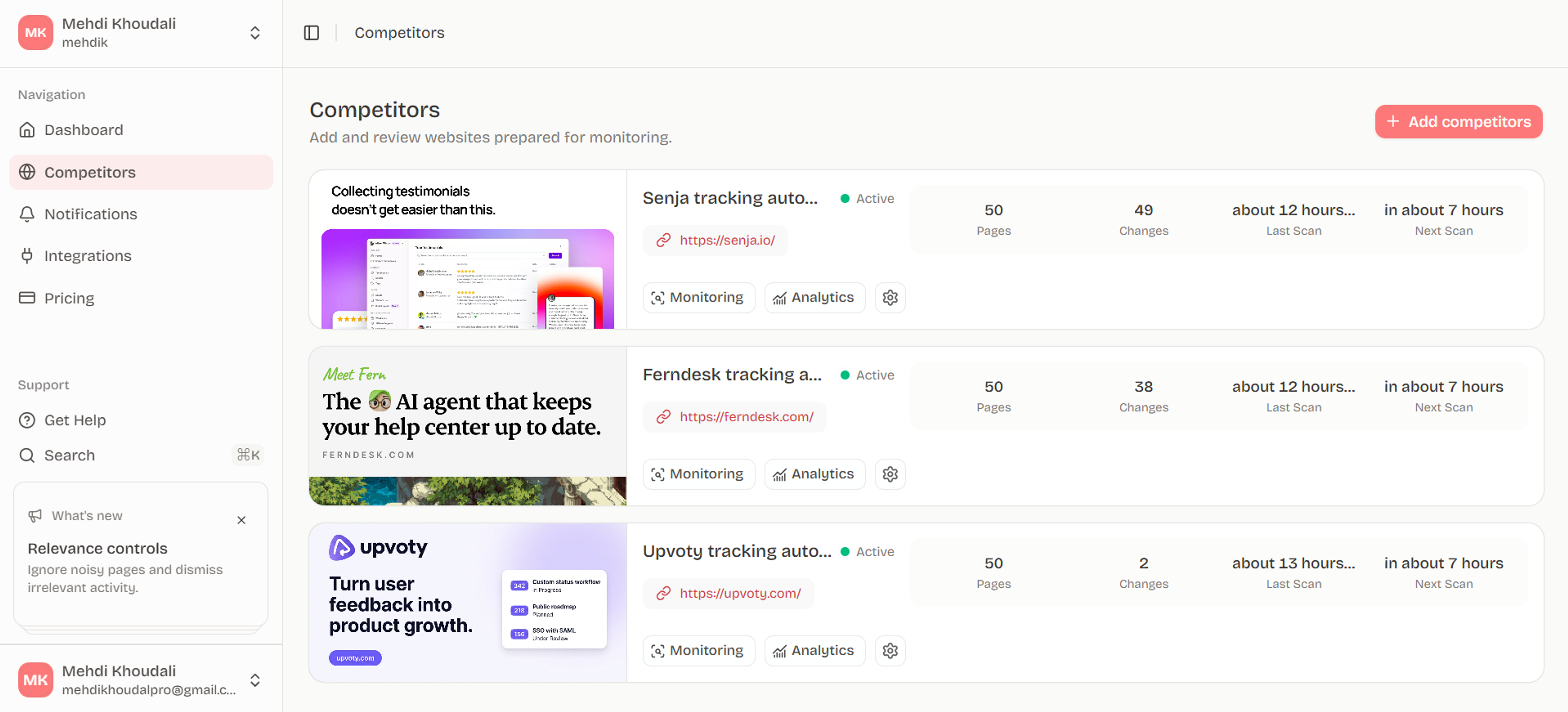
Ryvalise is designed around the website evidence layer of competitive intelligence. It crawls same-origin pages, classifies page types, keeps a stable monitoring core, filters volatile content, and summarizes meaningful changes across pricing, product, positioning, proof, and conversion pages. That makes it a strong first system for teams that want a defensible signal before adding a larger research stack.
The operating principle is simple: monitor the pages that can change a decision, preserve the source evidence, and make the next review smaller. You do not need a giant list of competitors to start. You need a few high-signal pages and a cadence that people will actually use.
A buying checklist you can reuse
Before committing, run the same five-page test against two or three tools: one pricing page, one product page, one changelog, one comparison page, and one page with dynamic content. Score each result for accuracy, noise, history, evidence, and alert usefulness. A polished dashboard cannot compensate for missed content or unexplained alerts.
| Test | Good result | Warning sign |
|---|---|---|
| Dynamic page | Stable, meaningful snapshot | Rotating content creates alerts |
| Pricing page | Plan and limit changes are clear | Only a pixel percentage appears |
| New page | Discovery or sitemap signal is visible | Only manually entered URLs work |
| Evidence | Source URL and before/after context | Summary cannot be audited |
| Alert routing | Importance matches consequence | Every change is urgent |
Frequently asked questions
What are the best competitor analysis tools?
The best tool is the one that covers the signal and workflow you need. Use a website monitor for public page changes, an SEO platform for search visibility, a social-listening platform for mentions, and a sales-enablement platform for battlecards.
Are competitor analysis tools worth paying for?
They are worth paying for when they replace recurring manual research or help a team act earlier on a meaningful market change. Estimate value from hours saved, missed changes avoided, and decisions improved rather than from the number of dashboards.
What should a small business monitor first?
Start with the competitor homepage, pricing page, core product page, comparison page, and changelog or resource hub. Choose pages that correspond to a current pricing, positioning, product, or sales question.
What is the difference between competitor analysis and competitive intelligence?
Competitor analysis is usually a focused comparison of specific companies. Competitive intelligence is the broader operating practice of collecting, validating, distributing, and using market and competitor evidence over time.
How often should competitor data be reviewed?
Review high-consequence pricing and launch pages as often as the decision requires, then group lower-urgency changes into a daily or weekly brief. Review frequency should follow consequence and volatility, not a universal schedule.
Put the research into motion
Start a focused competitor watchlist, then let Ryvalise turn website changes into source-backed signals your team can review.
Start with Ryvalise