Competitive intelligence
Competitive Intelligence Tools
A practical guide to competitive intelligence tools, what each category measures, and how to combine evidence into decisions.
Competitive intelligence tools help teams collect and use evidence about competitors, markets, customers, and category movement. They range from website monitors and SEO platforms to social listening, market databases, win-loss systems, and sales battlecard software.
Choosing competitive intelligence tools
Competitive intelligence tools are easier to compare when each one is tied to a job to be done.
Competitive intelligence tools by job to be done
There is no single universal tool because competitive intelligence contains several jobs. A monitoring product can detect that a page changed. An SEO platform can estimate that a competitor gained visibility. A win-loss platform can record why deals moved. A market database can surface funding or company events.
Choose the smallest combination that supports a real decision. If your immediate question is “which competitor changed its pricing page this month?”, a page monitor is more direct than a broad market-intelligence subscription. If your question is “why are we losing enterprise deals?”, public website data is useful context but not enough on its own.
| Intelligence job | Useful tool category | Output |
|---|---|---|
| Detect website changes | Page monitoring | Dated evidence and diffs |
| Find search gaps | SEO intelligence | Keyword and backlink estimates |
| Track public conversation | Social listening | Mentions and sentiment context |
| Understand deal outcomes | Win-loss | Buyer reasons and patterns |
| Equip sellers | Battlecards | Current objections and responses |
| Track company events | Market intelligence | Funding, hiring and news signals |
Enterprise CI suites
Crayon positions its platform around automated competitive intelligence, importance scoring, summaries, and sales activation. Klue combines competitive intelligence with win-loss programs and focuses on deal-based insights and workplace integrations. Kompyte emphasizes automated collection, AI filtering, battlecards, and win-loss reporting.
These suites make sense when a team has a formal intelligence program, multiple stakeholders, and a need to measure adoption. They can be heavier than necessary when a small team simply needs reliable evidence from a few competitor websites.
SEO and visibility platforms
Ahrefs, Semrush, SpyFu, Similarweb, and related platforms are strong for discovery and benchmarking. They help identify competing domains, ranking pages, paid search activity, referring domains, and estimated channel performance. Treat those numbers as modeled indicators rather than direct proof of a competitor’s internal results.
Use these tools to answer “where should we look?” Then use source monitoring to answer “what did the competitor publish, and when?” The distinction prevents an estimated traffic change from being presented as a confirmed strategic move.
Website change monitoring platforms
Website monitoring products usually differ by how they capture and compare pages. Visual tools compare screenshots. Text or DOM tools compare selected content. Browser-based tools can perform steps before extracting a page. API monitors compare structured responses.
For competitive intelligence, the best mode is often semantic and page-aware. A new plan, changed limit, new integration, or inserted blog entry is more useful than a one-pixel layout difference. Preserve a screenshot when visual context matters, but make the changed text and page type easy to review.
The evidence standard for CI
Every intelligence signal should answer four questions: what changed, where did it change, when was it observed, and what should the reader consider next? Add a fifth question for inference: which parts are interpretation rather than direct evidence?
- Keep the source URL and final canonical URL.
- Record the observation date and the prior comparison point.
- Quote only the minimum visible evidence needed to support the claim.
- Separate a published change from a hypothesis about intent.
- Link related pages when a conclusion depends on more than one source.
A useful operating cadence
Use immediate review only for high-consequence signals, such as a pricing change tied to an active deal or a product launch that changes a live sales conversation. Put routine website movement in a daily digest. Use a weekly review to identify sequences across pricing, product, positioning, proof, and conversion pages.
| Cadence | Best use | Example |
|---|---|---|
| Immediate | High consequence | Pricing or availability change |
| Daily | Triage | New pages and meaningful copy shifts |
| Weekly | Pattern review | Packaging and positioning sequence |
| Monthly | Program tuning | Competitor list and page priorities |
Connect tools without mixing evidence levels
Use a common record shape across sources: source, observation date, entity, signal type, evidence, confidence, and owner. A modeled traffic estimate should be marked as an estimate. A visible pricing edit should be marked as a published observation. A sales comment should be marked as buyer evidence. Keeping these categories distinct makes the final brief more trustworthy.
When several sources point in the same direction, describe the sequence rather than claiming causation. A new integration page, a job posting, and a product announcement may form a strong research lead. They still do not reveal the competitor’s private roadmap or revenue plan.
The smallest useful stack
For many teams, the first stack is one website-intelligence layer, one search-discovery source, and one place to review decisions. Add social, news, or win-loss systems only when they answer a question that the first stack cannot. Fewer connected tools usually create better adoption than a large set of disconnected subscriptions.
How Ryvalise fits a CI stack
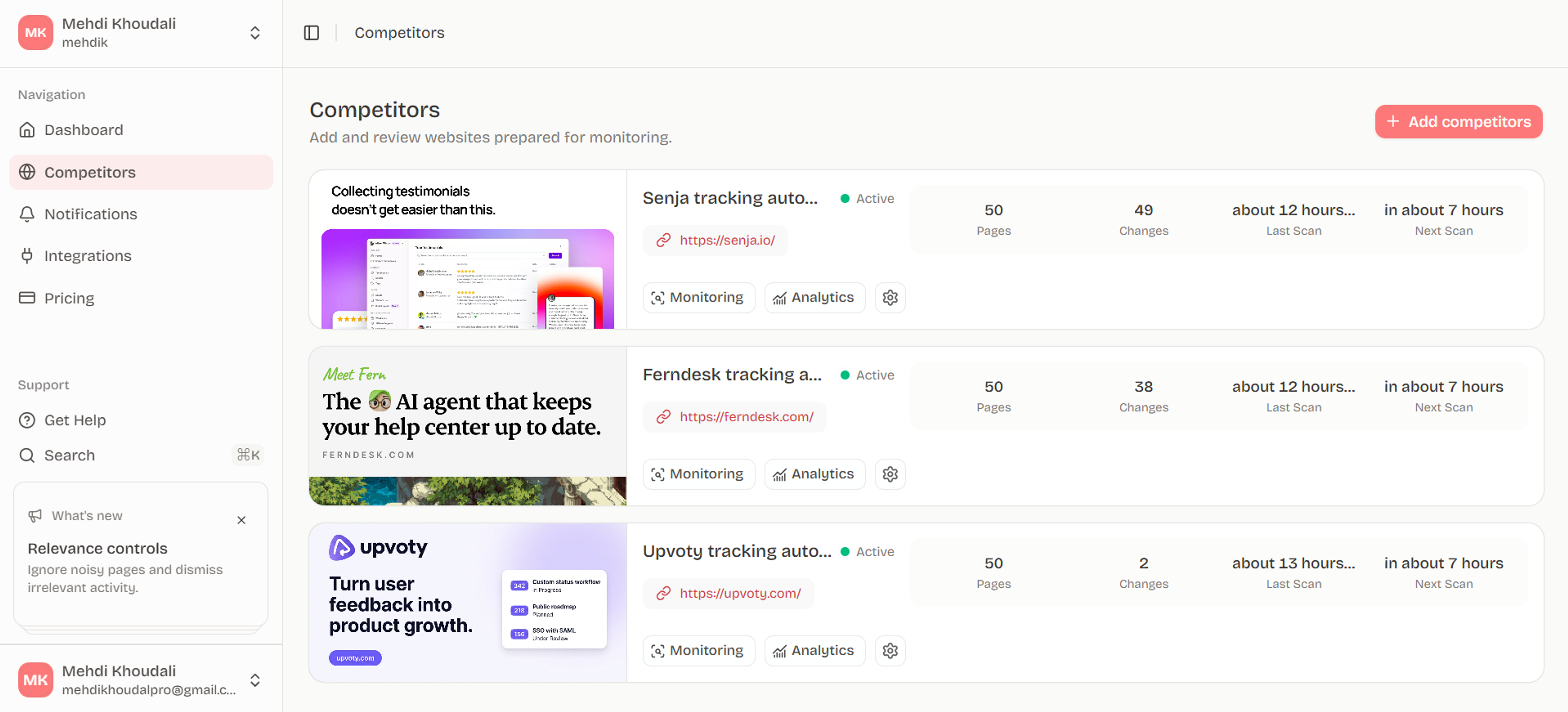
Ryvalise focuses on the public website layer: bounded crawling, page-type classification, stable monitoring, change evidence, and concise activity summaries. It can be the evidence foundation beneath product marketing, sales, or strategy workflows without pretending that a website alone explains buyer behavior.
That boundary is useful. The system can say what a company published while the responsible team decides what it means for roadmap, messaging, or sales. Good intelligence is not a dramatic conclusion; it is a trustworthy input to a decision.
Frequently asked questions
What are the best competitive intelligence tools?
The best options depend on the job. Crayon, Klue, and Kompyte suit formal CI and enablement programs; Ahrefs and Semrush suit SEO discovery; Visualping, Distill.io, changedetection.io, and Ryvalise suit website change monitoring.
What should a competitive intelligence platform include?
Look for source coverage, reliable collection, historical evidence, importance controls, collaboration, permissions, and a way to measure whether the resulting intelligence is used.
How is competitive intelligence different from market research?
Market research studies a market, audience, or category question. Competitive intelligence focuses on ongoing signals and decisions involving specific competitors and adjacent alternatives. The two practices often use the same sources but have different scopes.
Can AI replace a competitive intelligence analyst?
AI can help collect, classify, summarize, and route signals. It should not silently replace source review or turn a single edit into a confident claim about private strategy. Keep the evidence available and label inference.
How do I measure the ROI of CI tools?
Track hours saved, useful signals reviewed, time from change to decision, sales or product workflows influenced, and the cost of false positives. Tie measures to a baseline rather than a generic promise.
Put the research into motion
Turn competitor website activity into a reliable intelligence input with a bounded watchlist and source evidence.
Start with Ryvalise