Competitive intelligence
Competitive Intelligence Software
Compare competitive intelligence software by coverage, evidence quality, alerting, enablement, and fit for your team’s operating model.
Competitive intelligence software centralizes recurring evidence about competitors and markets so teams can make better product, marketing, sales, and strategy decisions. The category ranges from website monitoring to enterprise platforms with battlecards, win-loss analysis, and workflow integrations.
Choosing competitive intelligence software
Competitive intelligence software should reduce the time between a public signal and a useful decision.
What competitive intelligence software should solve
The software should reduce the time between a public signal and a useful decision. It should help you find changes, validate them, share them with the right owner, and keep a history that can be revisited later.
Do not judge a product by the number of sources alone. A thousand unranked signals can be less valuable than a small set of page changes with clear evidence and context. Start by naming the repeated work you want to improve.
Main categories of competitive intelligence software
Enterprise suites such as Crayon, Klue, and Kompyte emphasize intelligence programs, summaries, enablement, integrations, and adoption. SEO platforms such as Ahrefs and Semrush emphasize rankings, keywords, links, and paid-search data. Social-listening and market-intelligence products cover mentions, news, companies, and broader public conversation.
| Category | Strong for | Does not replace |
|---|---|---|
| Website intelligence | Published page changes | Buyer interviews |
| SEO intelligence | Search visibility | Source-page verification |
| Sales enablement | Battlecards and plays | Fresh collection by itself |
| Win-loss | Reasons for deal outcomes | Public web monitoring |
| Market intelligence | News and company events | Product-page diffs |
Website intelligence is the evidence layer
Pricing, product, comparison, integration, customer-story, changelog, and careers pages are high-signal sources. They show how a company presents its offer and where it is investing visible attention. Monitoring these pages provides a time-stamped record that can support a later analysis.
Visualping focuses on visual comparisons and highlighted screenshots. Distill.io combines selected elements, cloud monitoring, history, and multiple alerts. changedetection.io supports targeted elements, browser steps, filters, and broad notifications. A platform like Ryvalise adds a competitor-specific operating model around page types, crawl selection, stable monitoring, and activity summaries.
A buying framework for CI software
Score vendors on collection, interpretation, activation, and governance. Collection asks whether the right sources are covered reliably. Interpretation asks whether the signal is clear and evidence-backed. Activation asks whether the people who need the information will see it. Governance asks whether access, history, privacy, and ownership are controlled.
- Coverage: websites, pages, social, ads, jobs, reviews, search, news.
- Quality: rendering, canonical URLs, deduplication, volatility handling.
- Context: before-and-after evidence, timestamps, page type, source link.
- Activation: email, Slack, CRM, battlecard, dashboard, or brief.
- Governance: permissions, retention, auditability, and safe collection.
Build a business case without inflated promises
Estimate the current cost of manual research: hours per week, number of people involved, time to find a change, and time to explain it. Then measure the pilot with useful-signal rate, review time, false positives, and decisions influenced.
Do not claim that software directly increases win rate without a defensible measurement design. A more honest first milestone is reducing time spent searching and improving the freshness of the evidence used in a sales or product review.
How Ryvalise fits
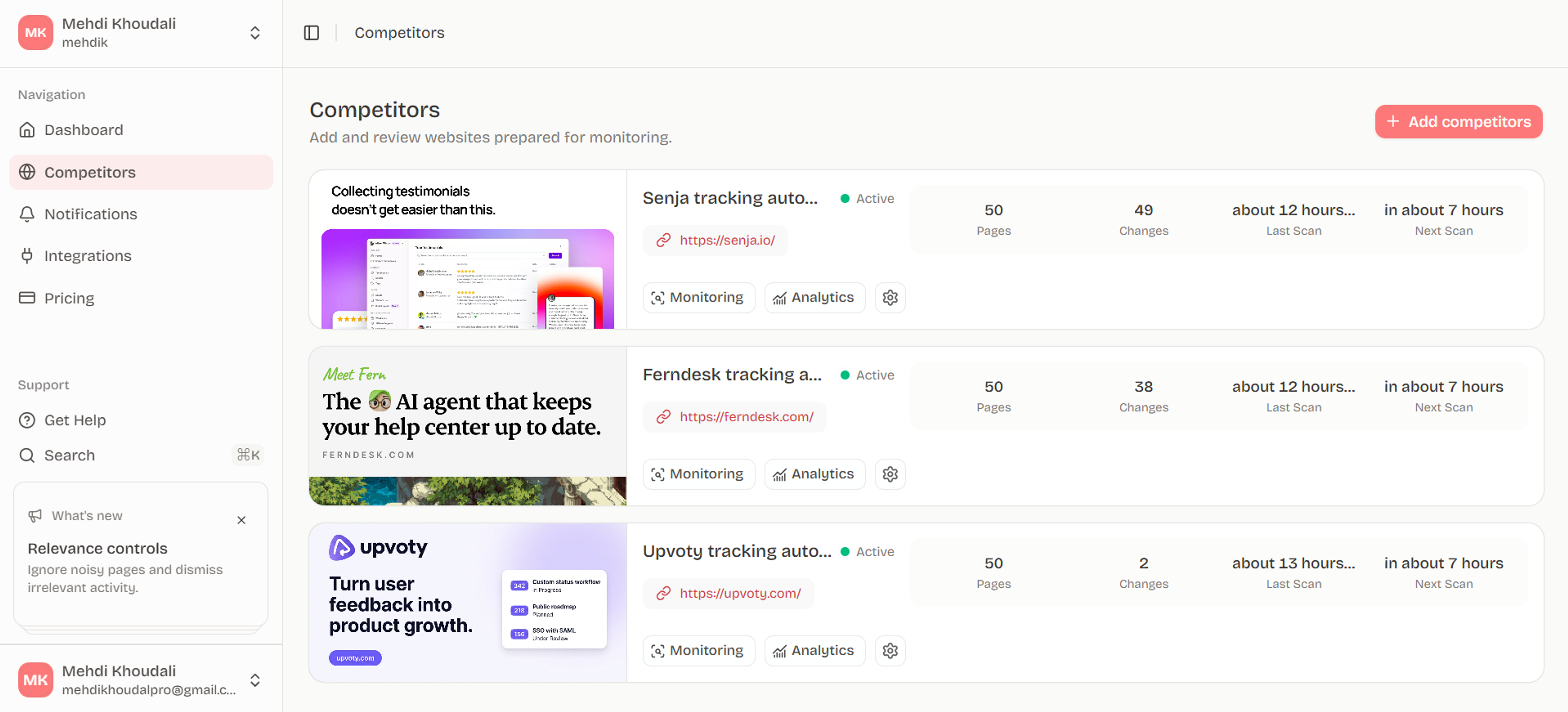
Ryvalise is focused on competitor website intelligence. It discovers and monitors a bounded set of pages, uses page types and structural signals to prioritize coverage, and preserves source evidence while keeping AI context downstream from scan success. This is a practical foundation for a team that needs reliable web changes before it adopts a larger CI program.
Questions to ask during a demo
Ask vendors to show a real alert from a page with dynamic content, not only a prepared dashboard. Request the prior and current evidence, the timestamp, the canonical URL, and the rule that decided the alert was important. Then ask what happens when a page temporarily returns incomplete content or redirects to another URL.
Also ask how ownership works. Who can change page priority? Who reviews ambiguous signals? Can a sales or product owner reach the source without an analyst rewriting the alert? A competitive-intelligence system is only as useful as its handoff from collection to action.
Start with a measurable pilot
Choose three competitors and five page types. Run the pilot for two weeks, record every alert, and classify each as useful, duplicate, cosmetic, incomplete, or missed. Measure review minutes and the number of decisions influenced. These measures reveal whether the software improves the operating system rather than merely producing more data.
Frequently asked questions
What is competitive intelligence software?
It is software that helps teams collect, organize, analyze, and distribute information about competitors and markets. Products vary widely in sources and workflows.
What is the best competitive intelligence software for a small team?
Choose a product that covers your first decision with low setup and clear evidence. A focused website-monitoring workflow can be more useful than an enterprise suite when the team is still forming its CI practice.
Does competitive intelligence software track pricing?
Some products monitor pricing pages, plan limits, billing language, and purchase paths. Confirm whether the tool captures rendered content, preserves history, and lets you distinguish meaningful pricing changes from page noise.
How does CI software help sales teams?
It can keep battlecards, objection handling, competitor claims, and recent evidence current. The content must be routed into the tools sellers already use or adoption will suffer.
Is competitive intelligence software the same as a CRM?
No. A CRM manages customer and deal records. CI software manages external market and competitor evidence, although integrations can connect the two workflows.
Put the research into motion
Start with a focused website-intelligence layer before you expand into a larger competitive program.
Start with Ryvalise